
Category Archives: Prevention News
Should you talk to kids about the “birds and the bees” and opioids?
As featured on Fox13 Salt Lake City –
“The opioid epidemic is not just an individual problem, it’s a community problem. There are things we can do to prevent misuse within our families and among our friends, and also ways to get involved in our communities.
Susannah Burt, Prevention Program Administrator for the Utah Division of Substance Abuse and Mental Health says anyone who uses an opioid is potentially at risk, and not just adults.
She says almost half (47 percent) of teens reported that it is easy to get prescription drugs from a parent’s medicine cabinet.
Nationally, 1 in 6 parents believes that using prescription drugs to get high is safer than using street drugs. More than 1 in 4 teens (27 percent) share the same belief.
Public education and awareness aimed at adults and adolescents is a big first step in prevention. The more people know and understand the issue, the more they can do to take charge of their health care, and health care of their loved ones.
Burt says it’s important for parents to have the talk with their children about the risks and dangers of prescription drug misuse. Set clear rules about no substance use, and create and maintain strong and healthy bonds with kids to help protect from the early onset of substance use.
Ask about alternatives to opioids when visiting with your doctor about pain management.
Be sure to lock up medications and safely through out medications that are no longer needed. You can visit useonlyasdirected.org to find a list of locations for drop boxes in your area.
Botvins Life Skills Training is currently being implemented statewide in all secondary schools. This program includes many skills that help protect youth from engaging in substance use. There is a focus on helping kids develop healthy life skills such as how to cope with anxiety, stress, and depression, how to make goals, how to make good friends, and how to refuse when someone offers them drugs.
Other prevention programs vary in focus depending on the target audience:
For children, Burt says, programs that focus on self-control, emotional awareness, communication, social problem solving and academic support are great.
For teens and young adults, programs that provide several hours a week of extracurricular activities, encourage academic excellence, provide healthy role models, and focus on communication, peer relationships, self-efficacy and assertiveness, drug resistance skills and reinforcement of anti-drug attitudes are important.”
Read full article:
2019 Stanly, NC Year in Review: The opioid epidemic
“For more than a year, Stanly County has been entrenched in a battle against the opioid epidemic.
At different times this past year, Stanly has led the state in the number of opioid overdoses per month resulting in emergency room visits, according to data released by the N.C. Department of Health and Human Services. From January to November, the county has had 92 opioid overdose ER visits, less than the 124 during the same time period last year.
The Center for Prevention Services in Charlotte was recently awarded a five-year, $1.25 million Partnership for Success Grant to serve Stanly. The grant, funded by the Substance Abuse and Mental Health Services Administration, began in October and runs through Sept. 30, 2024.
The grant provides approximately $260,000 per year to fund new efforts in Stanly aimed at reducing substance abuse. The grant will help in numerous way including providing a youth drug survey to students in the sixth, eighth, tenth and twelfth grades next spring. Training for middle and high school teachers and counselors over the next two years in the Botvin LifeSkills Training program, which has been used in 39 countries and has been shown to be effective in reducing alcohol, tobacco, marijuana and other drug use, will also be funded by the grant along with providing a trained youth coordinator to educate high school students about the dangers of drugs.”
Read full article:
Helping children make healthy choices
How the Barnardo’s LifeSkills programme is giving children the skills and resilience they need to thrive
As featured in Medium:
“My name is Alexandra, and I coordinate the LifeSkills programme in Waltham Forest which aims to improve the emotional health and wellbeing of children across the borough, by building their resilience and sense of self-worth so that they have the tools to deal with any stressful situations that may arise in the future.
I’m a local resident that lives in Leytonstone, having moved to London three years ago. My background is as a primary school teacher, a job I loved since I’ve always wanted to help children and young people live their best possible lives. However, my current role with Barnardo’s allows me to do this on a bigger scale — over the next three years I’ll be working with around 10,000 young people in years 4, 5 and 6.
LifeSkills is a long-term programme, and if there’s a challenge for me, it’s that I want to be able to solve problems as quickly as possible. But I keep in mind that what we’re doing is even more important — helping to stop children ever getting to the point that they face serious danger.
What is the LifeSkills Programme?
There are nearly 30 primary schools that are part of the programme. In each school, pupils in Years 4, 5 and 6 each receive eight one-hour lessons delivered by a teacher on things like dealing with stress, social skills and assertiveness.
The lessons are highly interactive and engaging, designed to be friendly and fun — as any programme is only effective if young people are engaged with it. The lessons are dynamic and interesting, using a range of teaching techniques such as listening to the teacher, talking with partners and rehearsing behaviours.
One of the nicest parts of the programme is that every child gets a lovely glossy workbook to keep every year that includes all the materials and their workings. Importantly, these books are not marked by a teacher — it’s one of the few parts of school life where what young people write is not judged. Children are just encouraged to write how they feel.
We aim to encourage children to recognise their own self-worth and to improve their ability to deal with stressful situations. Just knowing the information isn’t enough, or nobody would ever make dangerous decisions. We help children to identify different ways that they might be able to deal with stressful situations that may arise, from using deep breathing techniques to practising different ways to say ‘no’. This can then be applied to any situation, and can play a role in building resilience against violence — a key part of the borough’s Violence Reduction Partnership.
“I learned that you should think about your choices before you make them. I now know how to ‘Stop, Think, and Go’ when making a decision.”
Young person after LifeSkills lessons
Long-term impact
We know the programme works because we measure the changes in knowledge of young people before and after they take the classes. We can see how their knowledge, skills and attitudes have changed over the duration of the programme.
The headline figure is impressive: Children that complete the programme can reduce the likelihood of them smoking, drinking or taking drugs by 75%, , with effects lasting 12 years.
Initial results in Waltham Forest are promising: the evaluation of first group of nearly 2000 pupils shows they have demonstrated the best progression results seen in the UK with this delivery model.
LifeSkills has three distinct areas that it measures against — Knowledge, Attitudes and LifeSkills. These are the three components necessary to change children’s behaviour. This demonstrates the effectiveness of the programme in places where English is not always the first language.
The programme also works well when targeted at those more vulnerable young people. We run the programme at local pupil referral unit and they have seen the best results of any school in the borough — really positive evidence that the programme works for all children.
We’re now looking to expand the programme into a few local secondary schools, where Year 7 pupils will take part in the programme — a more developed and age-appropriate programme where other topics are covered such as violence in the media.
Positive feedback
I’ve been so pleased about how on board the schools have been. Although Barnardo’s provide the materials and training, schools have committed a lot of their own time to make the programme accessible and workable in their classes — no small feat given competing pressures on them.
Feedback from schools has been really positive; they mainly wish the programme was longer. We say to schools that this is the starting point and that teaching the lessons can give teachers a chance to open up a wider conversation about wellbeing which can highlight where there may be further specific things to focus on.
Parents have been really supportive too. Some parents initially had concerns about the programme, but being able to go and speak with them to allay any fears has been a really positive thing to. The huge evidence base behind the programme is very convincing! Mostly, I’m pleased that children love the classes. As a former primary school teacher, making learning fun and engaging is really important to me, and Botvin LifeSkills definitely does this!
Working with these primary schools has been a real privilege, getting to meet lovely pupils and hardworking teachers. I’m really looking forward to the next couple of years.
Read original article:
Dr. Gilbert J. Botvin Gives Keynote Address at Utah’s Safe and Healthy Schools Conference
WHITE PLAINS, NY – Dr. Gilbert J. Botvin, an internationally known expert in the field of prevention, delivered the keynote address at Utah’s Safe and Healthy Schools conference on November 12th in Sandy. Dr. Botvin is the developer of the highly acclaimed LifeSkills Training (LST) evidence-based substance abuse and violence prevention program that is currently taught in all middle schools in Utah. School district administration, resource officers, nurses, educators, mental health providers, and community prevention specialists gathered for the event, which focused on mental wellness, sexual violence prevention, and inclusive schools.
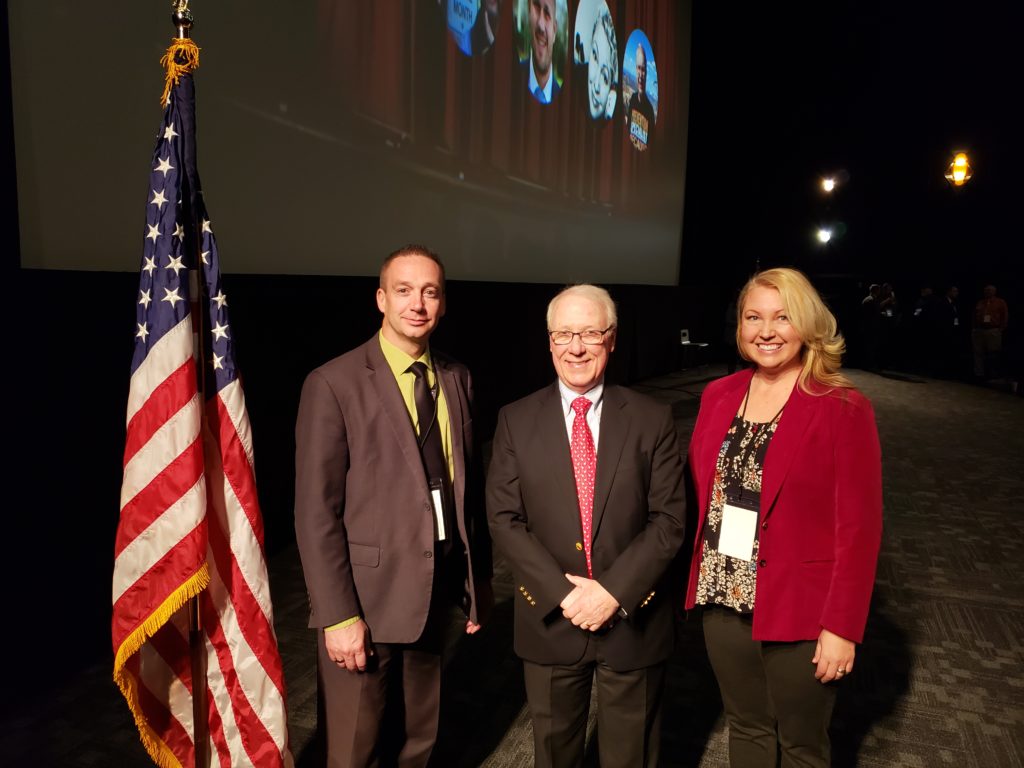
Dr. Botvin‘s keynote address, “Unleashing the Power of Prevention to Promote Safe and Healthy Schools,” described advances in prevention science over the past 35 years and the development of effective prevention approaches, with a focus on the LST approach. LST concentrates on providing children with the skills, knowledge, and attitudes to make healthy choices.
“Nearly 40 years of rigorous scientific study prove that evidence-based programs can prevent substance abuse and misuse, violence, and other risky behaviors,” said Dr. Botvin, Professor Emeritus at Cornell University’s Weill Medical College and president of National Health Promotion Associates. Dr. Botvin described LST and the theory supporting it, as well as evidence from more than 35 peer-reviewed publications documenting its effectiveness.
Participation in the LST program leads to the healthy development of self-esteem, emotional regulation, decision-making, communication, social skills, and ability to cope with stress. The program is proven to cut tobacco, alcohol, and illicit drug use and shown to produce prevention effects that can last 12 years or more. It can also prevent aggression and violence, delinquency, risky driving, and HIV/AIDS risk behaviors. In addition, independent researchers have demonstrated that LST can also shield adolescents from the misuse of opioid and other prescription drugs.
About Botvin LifeSkills Training
Botvin LifeSkills Training (LST) is an evidence-based substance abuse and violence prevention program. LST has been extensively tested and proven to reduce tobacco, alcohol, and illicit drug use by as much as 80%. Long-term follow-up studies show that it produces prevention effects that are durable and long-lasting. Visit www.lifeskillstraining.com for more information.
Contact:
Paulina Kalaj
Director, Communications & Media Relations
1-800-293-4969 ext. 214 | pkalaj@nhpamail.com
Milestone of ‘Kindness’: Health system announces yearlong campaign to promote wellness, donates to schools
The Conemaugh Health System will mark its 130th anniversary by delivering 130 “acts of kindness” to the three-county area its facilities serve.
Officials with the health system – whose roots date back to the formation of Conemaugh Valley Memorial Hospital in the wake of the 1889 Johnstown flood – announced the move Thursday inside their Memorial Medical Center campus, while making donations to 35 school districts across Blair, Cambria and Somerset counties.
“When we started talking about our anniversary … we started asking, how can we honor (our employees) while living up to our promise to make communities healthier,” Director of Marketing Communications Emily Korns said.
Hospital officials delivered on their first two acts this week.
The first was the completion of a fundraising campaign by the health system’s 3,450 employees that delivered $70,000 the United Way of the Laurel Highlands.
The other was announced Thursday in front of officials from a dozen schools spanning from Glendale to Rockwood Area, with Conemaugh Health System leaders making $250 donations to 35 schools from the communities they serve, while giving their students a year’s worth of access to a suite of interactive health and fitness programs.
“You have the pulse on your districts,” Korns told area educations Thursday, urging each to use the donations toward wellness efforts that fit their schools’ needs.
Divine Mercy Dean of Students Matt Ribblett welcomed the donation.
He noted the Catholic school has recently deployed the Botvin LifeSkills Training program – a well-known program created to encourage drug and alcohol prevention through healthier lifestyles. And it’s possible that funding could be directed there, Ribblett added.
Read full article:
LifeSkills Training Program to fill void
A school-based prevention program is on its way to Falls High School next fall.
In September, the school will implement Botvin LifeSkills Training, an evidence-based behavioral health curriculum, said BethAnne Slatinski, Planning and Implementation grant coordinator of Koochiching Area Prevention in Education, or KAPE.
“This came about because we didn’t have a law enforcement officer doing the DARE program (this year),” Slatinski said. “Locally, there isn’t an officer certified to teach the program.”
The curriculum will target sixth-grade students.
“Our goal is to teach kids how to make decisions surrounding drugs, alcohol and relationships,” Slatinski said. “They’ll also learn how to handle different types of peer pressure situations.”
In addition, the curriculum has a unit on advertising, which is a hot topic lately with vaping and e-cigarette companies targeting youth, Slatinski said.
“Kids really don’t believe a company like JUUL would specifically advertise to them,” she said. “I really like that advertising is part of it.”
Without the DARE program, this year’s sixth-grade students are still being exposed to different lessons based on similar principles of the program. Slatinski and another staff members are visiting the students once a month and doing different lessons.
“We’re making sure kids are learning what they need to learn and make healthy decisions,” she said.
Read full article:
Trust for America’s Health Releases Report: Addressing a Crisis: Cross-Sector Strategies to Prevent Adolescent Substance Use and Suicide
Trust for America’s Health released a report on the health and well-being of adolescents as an effort to advance a National Resilience Strategy. The report highlights several Blueprints-certified programs including the Botvin LifeSkills Training program.
The report highlights what works to decrease risks and build protective factors noting that strategies reducing adolescent substance misuse, suicide, and other negative outcomes will require an integrated, multi-sector approach grounded in prevention.
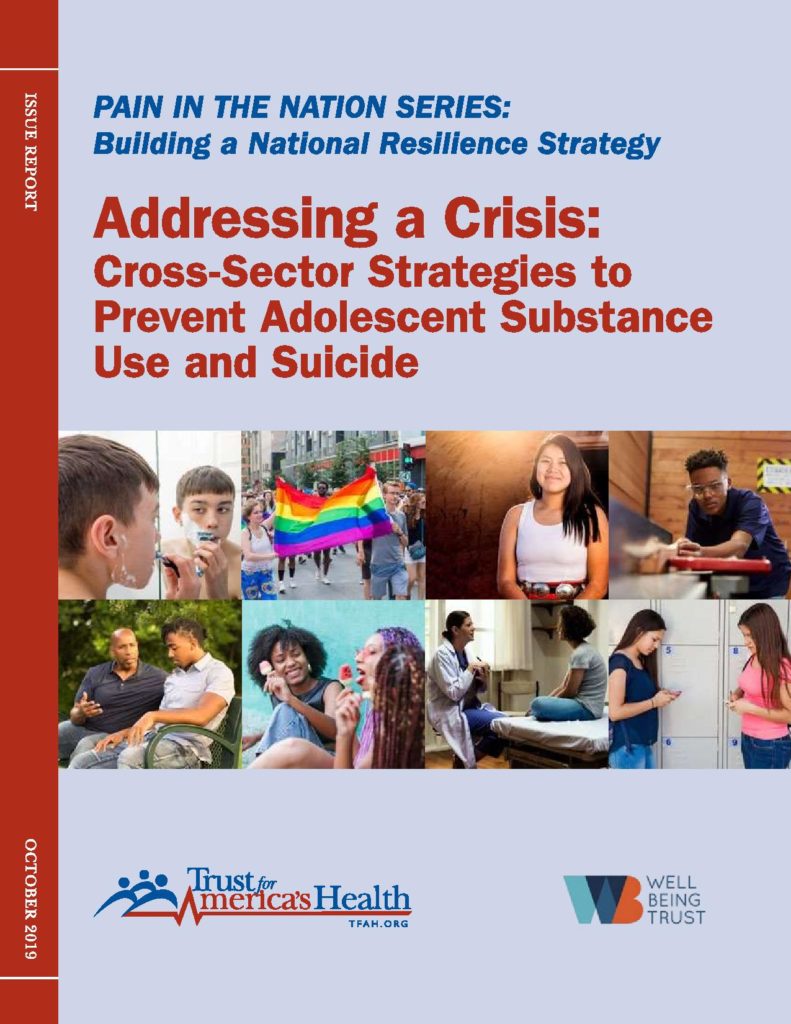
One of these prevention strategies is to build social and emotional skills during adolescence. Examples of social and emotional skills include emotional regulation, impulse control, stress management, and positive relationship skills.
“Social and emotional skills are key risk or protective factors for substance misuse and mental health disorders. Adolescents with poor social, communication, and problem-solving skills are at increased risk for depression; and those with poor coping skills are at increased risk for substance misuse. In contrast, studies closely link high levels of social and emotional skills to resiliency—or the ability to achieve or maintain positive outcomes in the face of adversity, such as poverty, discrimination, or trauma. Resilient adolescents are less likely to engage in risky behaviors— like substance misuse—and are better able to positively cope with stress.“
The report states that SEL programs implemented in early and middle childhood positively affects all measures of adolescent well-being.
“LifeSkills Training program, a three-year prevention curriculum for middle school students, promotes healthy alternatives to risky behaviors through activities that teach students the skills to resist peer pressure to smoke, drink, or use drugs; help students develop greater self-esteem and self-confidence; help students cope with anxiety; increase student knowledge of the consequences of substance misuse; and enhance decision-making and problem-solving skills. Evaluations over the past 20 years have found the program reduces the prevalence of tobacco, alcohol, and illicit drug use by 50 to 87 percent, and when combined with booster sessions, reduces long-term substance misuse by as much as 66 percent, with effects lasting beyond the high school years.”
You can read the report here: https://www.tfah.org/wp-content/uploads/2019/11/TFAH2019TeensPainRptFINAL10_24.pdf
Byron Middle School Awarded LifeSkills Grant
(Byron, MN) – (November 20, 2019) Byron Middle School has been selected to be part of the pool of eligible schools for the LifeSkills project (LST) with the Minnesota Department of Human Services. In August, Governor Tim Walz and Lieutenant Governor Peggy Flanagan announced that the State of Minnesota was awarded a $2.5 million grant to implement a groundbreaking, evidence-based social-emotional learning curriculum in middle schools across the state.
“We see every day the impact of substance use on Minnesota, and on our young. Too many deaths, too many damaged lives—we need to invest in evidence-based policies that have strong record of success,” said Governor Walz. “This grant from Arnold Ventures will help provide schools with a powerful tool to promote prevention and positive, long-term health of our kids.”
Principal Richard Swanson shared, “We are excited to have an opportunity to participate in an evidence-based program that focuses not only on substance abuse but the social and emotional learning needed to help our adolescents make sound decisions in all areas of life.” Based on more than 35 years of rigorous scientific research, the LifeSkills curriculum includes skills in resisting peer and media pressure to smoke, drink, or use drugs while also informing students of the consequences of substance abuse. According to Superintendent, Dr. Joey Page, “the grant will help students build their knowledge and skills to make important healthy choices.”
The grant, awarded by Arnold Ventures, will allow Byron Middle School to offer the LifeSkills Training program. “Prevention is a smart investment,” said Myron Frans, commissioner of Minnesota Management and Budget. “We are driven to support Minnesota by identifying programs that work and are cost-effective, such as LifeSkills Training. We owe it to all Minnesotans, especially those most impacted by substance use.”
The Minnesota Department of Human Services and Minnesota Management and Budget will partner to administer the grant. “This is an example of government collaborating and using proven methods to make a difference in the lives of Minnesota students,” said Acting Commissioner Pam Wheelock of the Minnesota Department of Human Services. “We are excited about this partnership and look forward to seeing real results.”
Read full release:
Monroe extension office prepping for 2020
Monroe County, Ohio’s extension office has had a busy 2019, with plans in the works for 2020.
Extension Office Associate Mary Jo Westfall is anticipating Community Development Block Grant funding next year.
“I’ll be working with commissioners to apply for some more CDBG funds,” she said. “Probably March we’ll have our first public hearing.”
She said $150,000 is available through CDBG’s allocation program.
“That’s the money the commissioners get every year,” she said. “The commissioners can choose up to four projects to do, and they’ll make that selection the spring next year.”
Ken Stewart, program assistant, also thanked the electorate for passing a five year 0.7-mill renewal levy. The levy passed by about 74 percent, with 2,423 voters in favor to 833 opposed.
“We can thank the voters for that,” he said. “We’ll continue programs such as 4-H.”
Stewart said the office’s work includes reaching out to the elementary schools with the Botvin LifeSkills Training, named after Gilbert Botvin, Ph.d.
“Basically it’s to teach seventh graders,” he said, adding the office was working with Woodsfield Elementary and Skyview Elementary. Among the chief objectives is to help discourage drug use.
“It involves 72 students and it helps them make better decisions and informed choices, and give them true statistics about smoking and alcohol and drug use, because a lot of times peer pressure is ‘everybody’s doing it,’ when you find out that it’s seven percent of the people your age are doing it, that doesn’t sound like everybody.”
Read full article:
Levine: Addiction is not a ‘moral failure’
Addressing the opioid crisis gripping the state and nation requires a multifaceted approach, beginning with understanding the core issue, the state’s top doctor told University of Pittsburgh at Johnstown students on Wednesday.
“Addiction is a medical condition. It is not a moral failure,” Dr. Rachel Levine, secretary of health, said during Pennsylvania Opioid Crisis and prevention forum in the John P. Murtha Center for Public Service and National Competitiveness.
Levine outlined the state’s response to the crisis as part of a panel of experts assembled by juniors and seniors in the educational law class under Ray Wrabley, political science professor and chairman of social sciences and business enterprise divisions at Pitt Johnstown.
Other speakers included Ronna Yablonski, Cambria County Drug Coalition executive director, Amy Arcurio, Greater Johnstown School District superintendent, Amy Snyder, Glendale School District teacher and Botvin LifeSkills facilitator, Fred Oliveros, Cambria County Drug and Alcohol Program administrator and Jason Rilogio, recovery work group chairman for the drug task force.
The state’s three-pillar approach to the opioid crisis is showing results, Levine said. The focus on prevention, rescue and treatment, has continued to reduce the number of overdose deaths since 2017, she said.
Read full article:


