


Category Archives: Prevention News

Northern Berkshire Schools, DA’s Office Team Up to Educate Kids on Drug Prevention

NORTH ADAMS — A 12th-grade student in Northern Berkshire County is twice as likely to binge drink than the average United State teenager. 

Facing similar data across a variety of age groups and substances, institutions across the region are teaming up to focus on prevention at an early age. 

Each school district in Northern Berkshire County has begun to implement the Botvin LifeSkills prevention curriculum, which sheds the old “just say no” model in favor of an approach that builds students’ decision-making abilities. 

“It is a program that really does work. It’s far from being ‘just say no,'” said Berkshire District Attorney David Capeless. “It does not simply explain to students about the kinds of choices they should be making or should not be making.”

The program is implemented by the Berkshire District Attorney’s Office, but superintendents of the Northern Berkshire school districts have been meeting since 2015. It covers more than 500 students in the towns of Adams, Florida, Cheshire, Clarksburg, North Adams and Williamstown, mostly between the sixth and ninth grades. 

“The pattern that we usually see is that by eighth grade, youth are already beginning to experiment with substances. So it’s really important that we think about prevention efforts that target youth before eighth grade,” said Wendy Penner, the coalition’s director of prevention and wellness. 

Examples of LifeSkills lessons include “Coping with Anxiety,” “Assertiveness,” and “Resolving Conflicts.”

Training in the curriculum began in November and 17 educators, ranging from physical education teachers to nurses, have signed on.

Community leaders, including Berkshire District Attorney David Capeless and school representatives, gathered at the Northern Berkshire Community Coalition offices on Monday to discuss the newly released substance abuse data and prevention plan. 

The data, gathered in a student survey thanks to funding from the Department of Public Health, indicates that 10th and 12th grade students in Northern Berkshire County perceive parents as having a lower perception of risk than the national average when it comes to substance use. 

The data was taken from students in the righth grade, 10th grade, and 12th grade. 

Between 2002 and 2017, the area saw noteworthy declines in alcohol use in all three grades, but it remains above the national average. During that same span, cigarette use has dropped across the board and rates have approached national averages. 

With marijuana, rates have remained steady over the past 15 years, with a notable uptick in the past two years among 12th-graders and eighth-graders. Marijuana can be a challenge due to the low perception of risk among students, according to Penner. 

“Typically what we see is that alcohol is the most commonly used substance by our youth, but what we’re starting to see is that marijuana is catching up to that in prevalence,” Penner said. 

A key part of the youth prevention effort actually targets adults. 

Citing data that indicates teenagers can base their substance choices on those of their parents, the coalition is issuing a parent engagement survey and plans to hold focus groups in June. 

Local doctors are also on board with the prevention effort. 

Northern Berkshire Pediatrics, the main healthcare provider for young people in North County, has begun a partnership with the community coalition and is beginning to provide children and parents with information regarding substance abuse at the age of 9. 

“We are really trying to put out there that [marijuana] is not a benign substance for the developing brain,” said Dr. Jennifer S. DeGrenier of Northern Berkshire Pediatrics. 

Read Full Article

Helping Youngsters Manage Their Feelings

A great deal of emphasis is placed on building the self-esteem of the pupils at Elliot Primary School and that’s why, every day, they pay compliments to one student.

The idea is that the other pupils all compliment the student, who is chosen at random, to make them feel celebrated, wanted and encouraged.

It is just one of the many techniques employed by teachers at the school through the PATHS Programme, run by PRIDE Bermuda, which is celebrating its 30th year of operating.

Since it was founded, PRIDE, whose mission statement is ‘To Prevent the Use and Abuse of Alcohol, Tobacco and Other Drugs Amongst Our Youth’, has helped more than 13,000 young people in Bermuda.

There have also been some significant milestones in terms of training and courses offered and in 1998 PRIDE implemented its continuum of youth programmes involving 18 schools and 120 members and in 2005, six schools implemented the PRIDE Pals Programme in their Primary 6-year curriculum.

In 2009 PRIDE Bermuda, in collaboration with Caron Bermuda, now Pathways Bermuda, launched the first phase of implementing a Student Assistance Programme.

A pilot of the LifeSkills Training Middle Programme, one of the SAP prevention programmes, was launched at Whitney Institute Middle School and in 2012 the three-year pilot was completed, where the results deemed the programme a success in improving student knowledge, and skills.

Other programmes include the High School LifeSkills, which is aimed at helping students cope with the challenges of high school.

The Parent Program is designed to help parents strengthen communication with their children and prevent them using substances.

 Read Full Article

Course Teaches 8th-graders the Right Skills to Say ‘No’

When Greater Johnstown middle school social studies teacher Christian Wrabley told his eighth-grade students they’d be taking an anti-drug course earlier this year, the response was a collective groan, he said.Johnsontown, PA

“A lot of them said, ‘We already know drugs are bad,’ ” he said.

“You could tell they were disinterested.”

Wrabley said he took it as a personal challenge – and members of the Cambria County Drug Coalition who joined him in his homeroom Tuesday said he was working with the right program to open their minds.

During one 45-minute Botvin LifeSkills course, Wrabley used personal stories, impactful and illustrative video clips – and even greeting cards – to deliver a lesson about making smart decisions to his class of eighth-graders.

And he never mentioned the word “drugs.”

“At this point in their lives, eighth-graders think they have everything figured out,” Wrabley said. “But there are teachable moments every day.”

Research shows the middle school years are more than just the “difficult” ones. Without the right support, teens can quickly end up on a path toward a life of bad decisions – whether it’s drug and alcohol abuse, violent tendencies or other self-destructive patterns, the program’s organizers say.

Botvin’s emphasis on developing the right “life skills” – good self-esteem, self-confidence and problem-solving prowess – has shown itself to be a difference-maker, United Way of the Laurel Highlands’ CEO William McKinney said.

On Tuesday afternoon, Wrabley focused his lessons on anger – one of several potential challenges to “self-management” that can otherewise lead to those destructive patterns.

He asked students to indicate if they’ve felt angry over the past 24 hours, and then pointed out to each of them that many classmates also struggle with the emotion, after more than half of the class raised their hands.

“See you’re not alone,” Wrabley said after one student, Noelle Smith, said she often used “mean words” to vent.

Another student said she felt “like a ticking time bomb” when her frustration begins to build up.

He encouraged students to share their thoughts about anger – and what makes them angry – at one point during class, and stressed the importance of “opening up” instead of bottling up stress.

Wrabley also reminded the class to think of how each other might be feeling in similar situations.

After student Shantia Jordan-Bradley noted that she didn’t get offended when other students “tease” her, Wrabley noted that other classmates might not react the same way.

He told a story commonly recalled by one of his relatives who was humiliated by fellow classmates while walking down the street 35 years ago.

“Sometimes things you think are a joke can stick with someone 35 years,” Wrabley said.

McKinney is hopeful the skills taught in Botvin courses across Cambria and Somerset counties will also stick with a generation of young people in the coming years.

Over the last six years, the research-based program has been implemented in classrooms across the region.

Lessons that reached 160 students in 2011 are now being taught to 7,500 in all 11 of Somerset County’s middle schools and 13 Cambria County ones. Blacklick Valley, Cambria Heights, Central Cambria, Conemaugh Valley, Ferndale Area, Forest Hills, Glendale Area, Greater Johnstown, Holy Name, Penn Cambria, Portage Area, Richland and Westmont Hilltop offer the course to at least one grade level and many offer it to several.

“We know this program works. We’ve seen the results,” he said, pointing to Pennsylvania Youth Survey data tracked in the years since that showed improved numbers about the awareness and the dangers of substances like marijuana, alcohol and pills.

As one example, a survey of 936 eighth-graders showed 53 percent fewer Cambria County students reported they “binged” on alcohol in 2015 compared to 2011.

In Somerset County, the willingness to try alcohol before age 21 dropped nearly 30 percent over the same span, while inhalant use dropped 86 percent.

McKinney and Cambria County Drug Coalition Executive Director Ronna Yablonski said the region will see the real benefits of Botvin’s results in the years and decades to come as a wave of young adults become adults who make better decisions than past generations.

She said she wants to see a day when area students begin taking the courses from third grade through eighth so that they have a solid foundation – and a belief in themselves – to make brave decisions even when life’s pressures to make bad choices become great.

Wrabley said he’s found himself adapting Botvin’s lessons to reach his Greater Johnstown classrooms – today’s urban youth – but said he believes in the program.

“Botvin (LifeSkills) reminds me why I’m here,” he said. “It reminds me that before I’m teaching civics, I’m teaching eighth-graders … and that there’s a whole foundation to lay before they trust you and feel comfortable.”

 The 11-week course might disrupt curriculum “but it’s in a positive way,” he told McKinney after his class ended.

Pointing to the problems and pressures students face each day, Wrabley said he can only hope it makes a difference.

But McKinney pointed to one student’s response to an assignment Wrabley gave the class earlier that day as a sign of hope.

Wrabley handed the class thank-you cards and envelopes, asking each student to write a letter of gratitude to someone who deserved it.

One student handed the card to Wrabley, thanking him for sticking by him, even though their relationship had been tumultuous much of the year.

Wrabley said he called the boy’s mother about his behavior on at least one occasion.

And the student had gotten in trouble outside school recently as well.

“He said he got mad at me … but realized I’m staying after school and doing these kinds of things because I care,” Wrabley said.

“To hear him recognize that, it’s rewarding.”

McKinney said the Botvin class provided the student a platform to listen and “open up” that he might not have received.

“We can see something positive is happening,” he said.

McKinney said he wants to see stories like that become common.

“Things are moving a lot faster for middle school students today than they were when we were in school,” he said. “That’s why it’s so important we have this program sustained for a long period of time. We’re looking five years, 10 years, 20 years out … to make sure we’re able to see the long-term benefits.”

Read Full Article

AG Healy Awards Opioid Prevention Grants for LST

MARLBOROUGH – Massachusetts Attorney General Maura Healey called for more opioid prevention and treatment programs to help end the epidemic that is ravaging the country, state and region.

Citing a statistic that 90 percent of adults with a drug or alcohol addiction started when they were under 18 years old, Healey stressed the need for an influx of youth education programs to teach students of all ages about the dangers of opioid use and addiction.

“Getting to young people at an earlier age is where it’s at and a good investment,” Healey said during a roundtable discussion with city and local leaders at Marlborough High School Wednesday. “… We know what could happen if we don’t reach kids in time.”

Healey’s office recently awarded $700,000 in grants to support school-based prevention education initiatives to address opioid dependence and addiction. Marlborough received a $20,000 grant to bring the Botvin LifeSkills Training program and curriculum to more than 1,500 students in grades 4-8. An adult program will complement the student program. The grant will also fund the hiring of a part-time licensed alcohol and drug counselor at Hildreth School and Marlborough High, said Superintendent Maureen Greulich.

“There’s no greater issue affecting families in our state than this crisis,” Healey said.

Read Full Article

NIDA: LST Shields Teens from Prescription Opioid Misuse

NIDA Notes – The LifeSkills Training (LST) prevention intervention, delivered in 7th grade classrooms, helps children avoid misusing prescription opioids throughout their teen years, NIDA-supported researchers report. Coupling LST with the Strengthening Families Program: for Parents and Youth 10–14 (SFP) enhances this protection.

Dr. D. Max Crowley from Duke University, with colleagues from Pennsylvania State University, evaluated the impacts of LST and two other school-based interventions on teens’ prescription opioid misuse. The researchers drew the data for the evaluation from a recent trial of the PROmoting School-community-university Partnerships to Enhance Resilience (PROSPER) prevention program. PROSPER is led jointly by Richard Spoth at Iowa State University and Mark Greenberg at Penn State University, with research funding from NIDA.

The new evaluation also disclosed that communities that implemented LST in the PROSPER trial more than recouped its cost in reduced health, social, and other expenditures related to teen prescription opioid misuse. The researchers recommend that communities consider implementing LST plus SFP to help control the ongoing epidemic of youth prescription opioid misuse. LST was the only intervention of the three tested that was effective by itself, and it was the most effective when the interventions were combined with SFP.
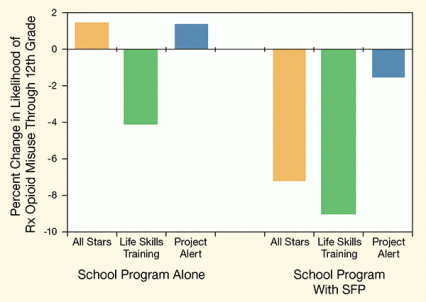
Graph
Figure. Evidence-Based Prevention Programs for 7th Graders Lower Risk for Prescription Opioid Misuse Before 12th GradeResearchers calculated that participating in Life Skills Training (LST) in 7th grade reduced a child’s likelihood of initiating prescription opioid misuse before 12th grade by 4.4 percent. Of the 6 prevention approaches used in the PROSPER study, LST plus Strengthening Families: for Parents and Youth 10−14 (SFP) reduced children’s risk of prescription opioid misuse the most.

Text Description of Graphic

Win-Win

Dr. Crowley and colleagues determined that LST’s impact on teens’ prescription opioid misuse made it a good financial, as well as health, investment for PROSPER communities. They reached this conclusion by:

  • Estimating the cost to prevent each case of prescription opioid misuse (by dividing the total cost of LST materials, training, etc., by the number of cases prevented).
  • Comparing that number to $7,500, which they estimated, based on previously established figures, is the average expenditure incurred by communities for each single case of teen prescription opioid misuse.

These calculations indicated that PROSPER communities that implemented LST laid out $613 and saved $6,887 for each child that the program prevented from misusing prescription opioids. The corresponding estimates for LST plus SFP indicated expenditures of $3,959 and savings of $3,541 per case averted. Even though communities saved less per benefited child with LST alone, the researchers note, their health benefits were greater and their total savings may have been greater with LST plus SFP, because more cases were prevented.

Numerous studies have shown that LST shields children against other substance use and problem behaviors in addition to LST (see LST’s Broader Impact on Substance Use). These benefits presumably would further increase communities’ economic advantage in implementing the program.

Dr. Crowley says, “This work illustrates that not only can existing universal prevention programs effectively prevent prescription drug misuse, they can also do so in a cost-effective manner. Our research demonstrates the unique opportunities to combine prevention across school and family settings to augment the larger prevention impact.”

LST’s Broader Impact on Substance Use

A study by researchers from Iowa State University led by Dr. Richard Spoth yielded results consistent with those of Dr. Crowley’s team, providing further support for LST as an effective tool for preventing substance use among youth. Dr. Spoth and colleagues randomized students from 36 Iowa schools into three experimental groups: LST alone, LST plus SFP, and a control group. Dr. Spoth’s team periodically collected questionnaire data from the study participants from 7th grade through age 22.

The researchers’ findings revealed significant effects of LST on outcomes when the students reached young adulthood, including fewer alcohol-related problems and lower cigarette and substance use. LST’s effects were more pronounced for those youth who were at higher risk for substance use. In light of these results, Dr. Spoth and colleagues conclude that LST may delay initiation of substance use and thereby decrease substance use and related problems in early adulthood.

Read Full Article

Foundation for Youth Pilots LifeSkills in Local Schools

Foundation For Youth is using state grant funding to pilot several new drug-abuse prevention programs in local schools, the Boys and Girls Club and after-school programs.

The $500,000 grant, funded through a two-year Communities That Care grant from the Indiana Department of Mental Health and Addiction, was awarded last summer for programs to educate children about substance abuse, said Andrea Vogel, director of the Communities That Care program offered through FFY.

The funding covers administrative and programming costs, in addition to training provided through the program. Vogel supervises an administrative staff of three people, and supervises 10 to 15 facilitators who present the programming in Bartholomew County.

At the end of March, the grant program has served about 1,000 individuals, Vogel said.

Vogel said she is hopeful that the grant, which became available last July, can be renewed in 2018 for another two-year cycle of programming.

Programs are provided from elementary through college levels and are focused on substance-abuse prevention, Vogel said.

The Communities That Care grant features several other components, including LifeSkills Training that helps students to develop coping, social and anger-management skills, in addition to teaching substance-abuse prevention, Vogel said.

“Youths are kind of bombarded with so many things … and to me, it’s important to provide them with as many skills as we can,” she said.

LifeSkills is being piloted in seventh-grade health classes at Northside Middle School, said Chuck Kime, Foundation For Youth executive director.

FFY is also partnering with the Bartholomew County Youth Services Center to offer the LifeSkills program at the juvenile facility.

Kime said the overall goal through the Communities That Care grant program is to give young people tools so they can be successful in life and make smart decisions.

One ongoing goal of the grant-funded programs is to look for ways to make them self-sustainable in the future in case the grant money does not materialize in the future, she said.

“We are out there as a resource,” Vogel said. “I hope to see an increase of the community collaboration (about substance-abuse prevention) that’s already started because that’s so important to all of this.”


Kent County making a Difference with Botvin LifeSkills Training

The Kent County Health Department is making a difference in the lives of children with the evidence-based substance use prevention program, Botvin LifeSkills Training. Studies show the LifeSkills program reduces smoking by up to 87% and alcohol use by up to 60%.

To date, over 100,000 Kent County students have received the program and teachers recommend the program to their colleagues. “Absolutely go for it!  It’s well worth it. It is up to date information. It is stuff that is very relevant to our students… ALL students,” Rebecca Flood, Wyoming Junior High School Health Teacher.

District Attorney’s Office brings LifeSkills to Prevent Drug Use

LANESBOROUGH, Mass. — The Berkshire district attorney’s office is now training educators on a specific curriculum to prevent drug use.

The office’s grant-funded Community Outreach and Education Program is now teaching “Botvin LifeSkills Training,” a three-pronged approach to help students make better decisions when presented with drug use. The curriculum is eyed to be rolled out into all schools and help prevent students from going down the path of drug use.

“The LifeSkills Training Program in itself has three components, teaching general social skills, personal skills, as well as drug abuse resistance. It hits decision making and it starts off in most levels — high schools are a little bit different — the elementary and middle school levels start off with self-esteem,” said Kim Blair of the district attorney’s office.

The office piloted the program in Lee Elementary last year and it is being replicated in other schools. The next step for the district attorney’s office staff to training the educators who are in the school every day to re-enforce the program.

“One of the things we will be doing is training educators. We’ve forecasted a number of trainings to train educators throughout Berkshire County in all levels of the life skills program,” Blair said.

The curriculum has multiple levels for different age groups. Real-life scenarios are presented to students to determine what they would do — practice of the skills they’ve learned for when it happens in real life. Blair said the scenarios replicate what a student could encounter, particularly when it comes to drug or alcohol use.

“Refusals go from no I don’t want to do it to do I have to tell a little white lie? Do I have to pretend my parents are coming to pick me up? Do I just ignore them?” Blair said. “We talk them through a lot of different ways to refuse and to deal with situations in their lives.”

Concurrently, the district attorney’s office has a peer-mentoring program. The Youth Advisory Board is an annual program that brings students from across the county to put on the Strive Leadership Conference. That conference has workshops and speakers that span issues many students are worried about — not just drug or alcohol use but other youth issues.

The efforts in the schools are all part of curbing drug behavior. Those two organizations presented their work to the Central County Rx / Heroin Work Group. The young students typically aren’t wrapped into the opioid crisis with very few actually reporting having addictions. But, by curbing the use of alcohol and drugs at the school level is what the program operators say will help prevent the student from delving into the harder drugs in the future.

Meanwhile, the Berkshire United Way has its own efforts to prevent drug abuse. Those include parenting workshops, awareness programs, and a social norms marketing campaign promoting positive decisions.

Between the various organizations and the schools themselves, there is much effort being placed on prevention. And the numbers are trending in the right direction, but there is still more work to be done.

More Information:  Read Full Article

Area Sixth Graders  Learn LifeSkills

KINGSFORD — The Dickinson-Iron County District Health Department recently conducted a LifeSkills program with all sixth-grade students in Kingsford Middle School.

The class was led by Kelly Rumpf, health educator. She taught LifeSkills to West Iron County and Forest Park sixth-grade students as well during the first semester and then Kingsford in this second semester. She met with students over a 12-week period, going back every week for an hour during their primetime class.

“LifeSkills educates youth and prolongs youths’ first use of drugs, alcohol, and other risky behaviors necessary to successfully and skillfully handle challenging situations,” Rumpf said.

Rather than merely giving information about the dangers of drug abuse, LifeSkills Training promotes healthy alternatives to risky behavior through activities designed to do the following:

— Teach students the necessary skills to resist social or peer pressures to smoke, drink, and use drugs;

— Help students develop greater self-esteem and build self-confidence;

— Enable students to effectively cope with anxiety;

— Increase students’ knowledge of immediate consequences of substance abuse;

— Enhance cognitive and behavioral competency to reduce and prevent a variety of health risk behavior.

More Information:  Read Full Article

PROSPER brings Prevention Programs to Pennsylvania Counties

LEWISTOWN — A new opportunity for youth is coming to Mifflin and Juniata counties.

A two-year grant has been awarded to Penn State and the Prevention Research Center in January to expand a program called PROSPER, Promoting School-community-university Partnerships to Enhance Resilience, to develop PROSPER communities in the two counties, as well as the Shikellamy School District. The program started in the early 2000s as a collaboration between Iowa State University and Penn State University and is now found in 12 counties in Pennsylvania.

PROSPER is a model for bringing evidence-based prevention programs to schools and communities with the goal of strengthening families, building youth skills and reducing youth substance use, as well as other problem behaviors.

PROSPER offers participating communities a menu of programs that are targeted toward middle school age children and consists of an in-school curriculum and an after-school curriculum. A Community Risk Survey was done by the CTC and prevention board in the school districts to find the youths’ strengths and challenges and looks for programs to address risk factors.

Kirk Gilbert, Penn State Extension leader who is heading up the program locally, said the school districts were given choices of what curriculum to use to best meet its needs. Both school districts have chosen the LifeSkills Training program for the in-school program of study and Strengthening the Family for after school.

LifeSkills Training provides students with skills for planning, problem-solving, peer resistance against problem behaviors, anger management, bullying and communication. Gilbert said studies have shown that these protective factors help youth avoid substance use and engaging in risk-taking behaviors.

Melissa Fausey, of the prevention board, said the new board lacks a lot of experience and resources, so this collaboration is a great fit because it gives them programming they wouldn’t have been able to offer for years.

LifeSkills Training is something we have been wanting for a long time,” Fausey said.    

The LifeSkills program will start in the fall at Tuscarora Junior High School and East Juniata High School and it is hoped that the Strengthening the Family program will start in both locations.

Records said she is thrilled to get these two top-rated programs implemented locally, especially since the programs are expensive.

Gilbert said the grant helps pay for materials for the programs, facilitators, meals, child care, training and observers who make sure the programs are delivered with fidelity.

Fausey said the cost/benefit analysis for every $1 invested into prevention is roughly a $5.30 cost savings, which she said is a very conservative figure.

“It’s hard to put a price tag on prevention,” Fausey said. “There really is a cost/benefit instead of intervention and recovery costs. If we focus funding into prevention, it will help us come out ahead in the end.”

“Prevention needs the community behind it and to get as many people involved as possible,” Fausey said.

More Information: Read Full Article