


Category Archives: Prevention News
Introducing: Botvin LifeSkills Training Module to Prevent Rx Drug & Opioid Abuse
Webinar: Opioid and prescription drug abuse is an epidemic that demands our immediate attention. At Botvin LifeSkills Training (LST) we are putting our experience, expertise, and resources to work helping schools and community agencies prevent youth from abusing prescription drugs, including opioids.
The new LST Prescription Drug Abuse Prevention Module provides students with the skills and knowledge necessary to avoid the abuse of opioids and prescription drugs. This new module will enhance the documented effects of the LST Middle School program. A study funded by National Institute on Drug Abuse (NIDA) showed that the LST Middle School program delivered in 7th grade classrooms helped students avoid abusing prescriptions opioids and other drugs throughout their teen years.
We hope you will join us to learn about this exciting new prevention tool for teachers and facilitators to use with the youth they serve. The module will be available in both digital and print formats to allow for use in a variety of settings, including school classrooms and community centers.
Duration: 30 minutes
Click link to register: Many dates to choose from (space is limited)
After registering you will receive a confirmation email containing information about joining the webinar.
Our Opinion: The Long Campaign on Opioid Addiction
Posted Friday, August 11, 2017 6:24 pm
It’s a quiet kind of death — it doesn’t involve mass shootings, airplanes getting blown out of the sky by extremists or the crash of metal as cars colliding at an intersection. Nevertheless, fatalities from drug overdoses have achieved epidemic proportions. Just last week, the President’s Commission on Combating Drug Addiction and the Opioid Crisis released a report containing an eye-opening statement: “The opioid epidemic we are facing is unparalleled. The average American would likely be shocked to know that drug overdoses now kill more people than gun homicides and car crashes combined.”
Opioids comprise not only street heroin and its synthetically-produced relative, fentanyl, but also prescription painkillers — and therein lies the reason that this class of drugs has achieved such a foothold in this country. According to the Substance Abuse and Mental Health Services Administration, over 97 million people took prescription painkillers in 2015 (the latest year for which statistics are available), out of which 12 million used them in ways not sanctioned by a medical professional. In 2016, drug overdoses killed an estimated 59,000 people in the United States.
That same year, the Massachusetts Department of Public Health estimated that 1,979 residents died from an opioid-related overdose, according to The Boston Globe.
We are long past the point of looking at opioid addiction merely as a law enforcement or interdiction of supply issue. The epidemic has become so severe that we must attack it in a comprehensive way that employs a whole spectrum of strategies also include prevention programs, addiction treatment and counseling…
… In the meantime, the rate of addiction and overdoses continues to grow, and this country must begin to realize that treating the symptoms and consequences of addiction is only a rear-guard action. If victory in this battle is ever to be achieved, we must address the underlying social causes that lead to addiction in the first place. To that end, the Berkshire County District Attorney’s office recently instituted a youth substance abuse education program called LifeSkills Training, to help county students communication skills, resiliency and the ability to make good decisions.
The DA’s office has been joined by the Brien Center and several other Berkshire organizations in this good fight. However, the entire journey to free the county, state and nation from the chains of addiction will take years of effort, and funding, at the local, state and federal levels.
Letters: Kudos to Grant-Maker, Volunteers for Schools Program
To the editor:
The Brown County Community Foundation would like to thank AT&T and their representative, Pepper Mulherin, for their recent $10,000 grant supporting Brown County Schools. This grant will allow the high school to acquire the Botvin LifeSkills curriculum. This curriculum is primarily a drug prevention program but also contains specific units related to suicide prevention and bullying prevention by teaching proactive and positive social skills to students. There is a specific ninth and 10th grade curriculum and a specific 11th and 12th grade curriculum so the program is very focused and comprehensive.
The Brown County Rotary Club members who already are very active in a number of other school activities, including assisting with science and history project judging and the RYLA leadership skill building program, have expressed an interest in helping to develop an implementation plan and delivering the curriculum. We are blessed to have such wonderful financial support from AT&T and volunteer organizations like Rotary ready to provide valuable volunteer support to our school system.
Congratulations to Brown County Schools on dedicating the time and energy to submit the application and receive the grant, and a heartfelt thank you to AT&T for their generous grant support for our school system.
Larry Pejeau, CEO, BCCF
Coming Soon: LifeSkills Prescription Drug Prevention Module
The opioid epidemic has the nation’s attention as overdoses continue to increase. Opioids are still commonly prescribed as painkillers for medical reasons. As schools and communities search for an opioid abuse / misuse education curriculum, National Health Promotion Associates, the researchers behind Botvin LifeSkills Training, have developed a prescription drug (Rx) abuse prevention module to help young adults learn healthy behavioral social and self-regulation skills such as managing stress and anxiety, as well as drug resistance skills. The combination of drug resistance skills and life skills has been proven to be a powerful formula for preventing drug use and can be carried over throughout their teen years.
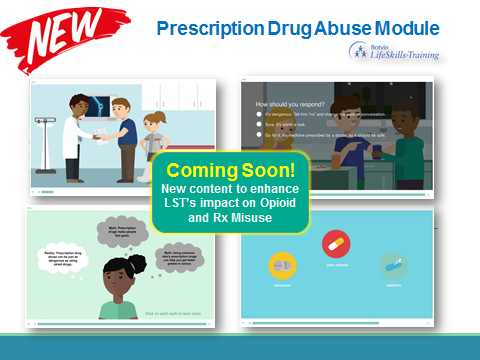
Interested in learning more about the LifeSkills Training Prescription Drug Abuse Module? Email us at lstinfo@nhpamail.com for more information.
For Drug/Alcohol Prevention, Good Intentions Not Enough
Robert Slavin, Contributor
Director of the Center for Research and Reform in Education at Johns Hopkins University School of Education
05/04/2017 03:30 pm ET | Updated May 09, 2017
Every year, I learn something at the AERA meetings, but it never has anything to do with what’s on the program. Last year it was about recycling. This year, it was about ineffective but heart-tugging programs.
One morning in San Antonio, I came out of a restaurant after breakfast and there were two very sweet-looking middle school girls who were collecting money for their school’s DARE program. DARE (Drug Abuse Resistance Education) is a very widespread program that is designed to reduce drug and alcohol use. Police officers speak to students and get them to sign a pledge not to use drugs or alcohol. The girls told me DARE had now added a focus on preventing suicide. I was impressed by their presentation, and gave them twenty bucks.
Why do I consider this mundane transaction blog-worthy? The answer is that it just so happens that DARE is the very anti-poster child among advocates for evidence-based reform. It’s seen as an appealing-sounding yet ineffective program. According to Blueprints (www.blueprints.org), which rigorously reviews mostly drug, alcohol, and delinquency prevention programs, does not rate DARE as effective, and numerous reports of large-scale evaluations found no benefits. In 2001, the U.S. Surgeon General put DARE on a list of ineffective and sometimes counterproductive programs.
Further, Blueprints certifies alternatives to DARE that have been rigorously evaluated and found to be effective in reducing drug and alcohol use among teens. For example, Blueprints lists the following programs as meeting its “model” criterion or better for middle school students: Lifeskills Training (LST), Multisystemic Therapy (MST), Functional Family Therapy (FFT), and Positive Action. Several other programs met the Blueprints “Promising” standard.rmail
Knowing all this, why did I contribute? Clearly, I contributed from my heart, not my mind. The girls were very sincere, and believe fervently in what they were doing. From their perspective they were not advocating for a specific program, they were taking a personal stand against drugs and alcohol abuse, and I think that was admirable, so I admired it, to the extent of $20.
At the same time, I recognized the irony, and also thought about how government and philanthropists must see DARE, and many other programs intended to improve social and educational outcomes for youth. They must equally see programs that are sincere, appealing, and clearly offered by good people to do good things. They are probably not aware that there are proven alternatives offered by equally good people to accomplish equally valuable goals, which happen to actually make a difference. Evidence just does not play much of a role, if any, in these decisions. Supporting good causes is inherently good, isn’t it?
The problem is that government and philanthropic resources and attention are limited, and if these resources are tied up in ineffective or untested programs, they are not going to support proven alternatives that could actually move the needle.
Worse, funding DARE instead of proven alternatives may eventually put the alternative programs out of operation, and convince good-hearted people who want to improve outcomes for youth that doing rigorous evaluations of their programs is foolish.
Neither those middle school girls nor their teachers nor probably their principals could change the situation in which they find themselves. Even if they knew full well that DARE has not been shown to be effective, it is morally irresponsible to do nothing about drug and alcohol abuse, and DARE may be the only approach they have on offer.
Yet at higher levels in the system, there is a responsibility to find out which drug and alcohol prevention programs are truly effective and to invest in those. Such programs are easily found on Blueprints, for example, if only our leaders were in the habit of consulting it. Those middle school girls could just as well have been collecting for a program that works. Had they been doing so, I would have been a lot happier about the fate of my 20 bucks, not only because it might actually reduce drug and alcohol abuse, but because it would also indicate a changed mindset, one that values actual impact rather than just good intentions.
Congratulations to the Newly Certified LifeSkills TOTs
Congratulations to the participants of the White Plains, NY Training of Trainers (TOT) Workshop. During this two-day course led by Alayne MacArthur, National Health Promotion Associates (NHPA) Lead Trainer, participants from all over the U.S. learned how to deliver and conduct Lifeskills Provider Training Workshops for their respective organizations.
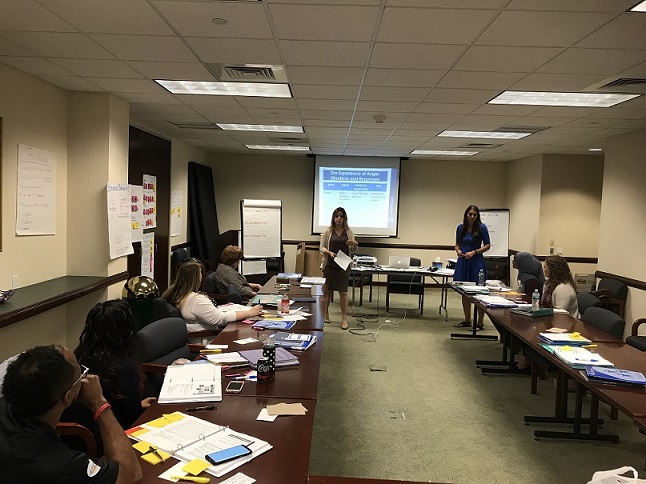
Customizable training services are available through National Health Promotion Associates, Inc. (NHPA), a health consulting, research, and development firm founded by Dr. Botvin, the developer of the Botvin LifeSkills Training (LST) program.
LifeSkills Provider Training Workshops prepare teachers, school counselors, prevention specialists, police officers, community youth educators, and other program providers to effectively implement the state-of-the-art prevention education activities and teaching strategies found in the LST program.
Each workshop plays an important role in enhancing the confidence and skill capacity of participants, resulting in optimal implementation of the LST program. While training is not required, it is highly recommended in order to achieve optimal program results. Training increases the effectiveness of the program and assists providers to develop implementation strategies for the programs comfort and fit in individual sites.
Grant to help RE-1 Valley with Substance Abuse Prevention
By Callie Jones
Journal-Advocate news editor
Sixth through ninth grade students in RE-1 Valley School District will benefit from an additional mental health professional this upcoming school year thanks to a $200,000 School Health Professionals Grant the district has received from Colorado Department of Education.
“We are really thrilled,” said Superintendent Dr. Jan DeLay, noting RE-1 was one of many school districts to apply for the limited grant funds.
The grant program is intended to help schools provide substance abuse and mental/behavioral health care to students who have substance abuse or other mental/behavioral issues; implement substance abuse prevention education and provide evidenced based resources to school staff, students and families; and reduce barriers for secondary students at risk for substance abuse to access services provided by community-based organizations for treatment and counseling.
RE-1’s grant application was submitted by Michelle Long, district mental health professional; Dr. Lois Christiansen, district psychologist; Kris Schell, district social worker; Laurie Kjosness, director of student services; and Ronda Conger, YouthLink coordinator.
Funds from the grant will allow RE-1 to hire a full-time mental health professional, either a counselor or social worker, to work with sixth through ninth grade students at Sterling Middle School, Sterling High School and Caliche Jr./Sr. High School for the next three years. This individual will help launch the HEADS-UP (Health Education, Adolescent Development and Substance Use Prevention) program, which will prepare students to increase self-esteem, critical thinking skills, resiliency, confidence, and self-direction while focusing on substance use prevention and behavioral health education that will result in students being able to successfully handle challenging situations.
Advertisement
The HEADS-UP program will use Botvin Life Skills Training (LST) program, which focuses on normative beliefs about substance use and substance use refusal skills, violence and delinquency, and substance use (alcohol, tobacco, inhalants, marijuana, and polydrug). It addresses multiple risk and protective factors and teaches personal and social skills that build resilience and help youth navigate development tasks, including the skills necessary to understand and resist drug influences.
As part of the HEADS-UP program, there will be trainings for staff, students and parents.
The grant application notes that since the legalization of marijuana in Colorado, while Logan County itself does not have any dispensaries, there are many located in nearby communities, which has increased access to marijuana, as well as other illegal substances. RE-1 has already established a collaborative working relationship with community resources and supports, but state in the grant application that the grant funds are needed in order to continue to build those relationships and implement a comprehensive school-based program in an effort to reduce the risks of alcohol, tobacco, drug use and violence in the community.
According to the grant application, RE-1 is in great need of an additional health professional to meet the needs of the increasing number of students with substance abuse and behavioral health care issues.
The Center for Disease Control’s Healthy People 2020 recommends one school nurse for every 750 general educations students, the National School Social Worker Practice Model recommends one school social worker for every 250 students, the National Association of School Psychologists recommends one school psychologist to every 500-750 students and the American School Counselor Association recommends one school counselor to every 250 students. RE-1 serves just over 2,100 students from preschool to age 21 and employs one school nurse, one school psychologist, one social worker and three high school counselors.
Included in the grant application are comments showing how the attitudes and actions of students in RE-1 have changed since the legalization of marijuana:
- “There’s a shift in culture; kids see their parents smoking marijuana and see it marketed everywhere, and they think it’s normal and OK for them to do.”
- “At our elementary and preschool school, we have noticed an increased number of parents showing up at school, high.”
- “Kids have brought marijuana to school to show their friends.”
- “They go off campus and smoke during lunch with friends.”
The grant application notes that 10 years ago it was rare to see incidents of drug-related disciplinary actions given to students, but those actions have increased dramatically. In Aug. 2015, 188 school counselors in Colorado participated in a survey concerning the legalization of marijuana in schools. They were asked a number of questions including since the legalization of marijuana, what impact has there been on marijuana-related incidents at your school? 69 percent of counselors reported an increase in incidents, 30 percent reported no change in incidents and 2 percent reported a slight decrease.
When asked what the most predominant marijuana violations by students on campus were, 51 percent of counselors said being under the influence during school hours, 30 percent said possession of marijuana, 9 percent said possession of marijuana-infused edibles, 6 percent reported sharing marijuana with other students and 5 percent said selling marijuana to other students.
Community Resource Center Unveils New Programing
By Linda Provost
The Duncan Banner
As part of the change from a youth shelter to a community resource center, Youth Services of Stephens County will have three new programs to invest in and support children and families in the area.
Sara Orellana-Paape, Executive Director for Youth Services of Stephens County, said the three programs would begin Sept. 1. Two of the programs will be a partnership endeavor with Duncan Public Schools (DPS) to create needed outreach for students.
“In this plan, we will be partnering with Duncan Public Schools to work with suspended youth in the 6th through 12th grade to help them continue to maintain their education, their education skills, as well as to provide them with life skills and anger management skills to prevent further suspensions as well as to prevent further office calls,” Orellana-Paape said. “Our main goal is to greatly increase the amount of classroom and instruction time that every student has. In the afternoon, we will be partnering with Gabriel’s House to … extend after-school care by providing an after-school program for 6th through 8th grade.”
Michele Scott, Director of Special Services for DPS and Youth Services board member, said the partnership was mutually beneficial for both parties.
“As we have talked to community members, as well as trying to bring those stakeholders in, one of the big things is just linking students with additional services and those families that … [which] may be struggling for whatever reason — we want to provide good wrap-around services for all of our students,” Scott said. “ — When we began to talk with Stephens County Youth Services, this was a great way to reach out to a population of individuals and families that needed some additional service that we know Youth Services can provide. We’ll work closely together providing some things, like transportation and computers — so students will be able to stay on track while they are suspended, but at the same time working to gain some new skills so that … doesn’t happen again.”
Scott said many times when a student is suspended, they are home alone or just out and about and hopes the skills learned in this program will be a “tool in their toolbox.”
“Parents will have a choice when we talk about discipline in the school system — parents will be part of the decisions — the programs that the student needs to be in, or is there something different that we need to look at? Parents are actively involved,” Scott said.
Scott said another great part about the program is that each group there during the day gets a meal.
“That’s a huge need in our community that probably goes underreported,” she said.
The outreach to the whole family is something both organizations were looking forward being able to have time for.
“Our goal is to create more of a wrap-around service, whereby talking to the kids, we identify the main problem — maybe mom is underemployed and so we connect mom with resources that help her gain gainful employment,” Orellana-Paape said. “Maybe brother has dropped out of high school and we connect him with services to get his GED. Our goal is to help everybody in the family — not just the child, because research shows if we can get a stable support system in the home where the child is, that child will excel and their problems will minimize.”
The shelter is already beginning the physical transformation to host these new programs.
“We [are] definitely starting small as a community resource center — The first two [programs] are the suspension prevention programs. The morning is for 6th through 8th grade, the afternoon is for 9th through 12th [grade],” Orellana-Paape said. “In those programs kids will receive a meal, they will receive time and access to do their school work, they will participate in community meetings where we’ll be able to talk about their feelings and their emotions, as well as why they are in the situation that they are in. They’ll also participate in BotVin Life Skills, which is a research-based curriculum that will give them communication skills. It will help them manage their anger, it will help them identify why they’re feeling the way they do.”
Another requirement of being in the suspension prevention program is a joint class with the child and a parent or guardian.
“Our ‘first offenders’ class, which is another research-based program that has a very high success rate — between 80 and 90 percent,” said Orellana-Paape. “They focus on communication, anger management, ways to parent a teenager, ways to appropriately express emotions. One thing I always say is that at my age of 37, I struggle to identify my emotions. I could — be like ‘I’m upset, I’m upset’ and maybe that is the top-most emotion that I am feeling, but with help and working through it, it can come down to ‘I’m overwhelmed,’ ‘I’m tired.’— So I always stay very keenly aware that if I struggle this much at my age and with the experience that I have — I can only imagine the struggles that kids have.”
The after school program will start late afternoon.
“In the afternoon, with the help of Gabriel’s House, we are going to create a unique after school program for 6th through 8th grade. — [It] will be more come-and-go because they need more independence and it’s going to be very career-oriented, very positive, we are going to work on driving self-esteem, self-worth,” said Orellana-Paape. “Of course there will be a place for them to work on homework and access things that they need and get help. But in addition we’re talk about what are your career goals, we’re going to bring community members in. … I would love to partner with other industries in the community.”
For more information or to get involved with Youth Services contact the office at 580-255-8800.
Summer workshops: “Teaching Marijuana Prevention”
NHPA is pleased to offer Substance Abuse Prevention Workshops designed for health educators and professionals seeking to expand their experience, knowledge, and skills related to prevention education.
The status of marijuana has undergone rapid legal and cultural shifts in recent years. These changes present speci

fic challenges to school and community health educators.
In this workshop, participants will explore the social and legal trends in acceptance, the pharmacology of marijuana, and effective strategies for responding to the misconceptions adolescents hold about marijuana.
Join us for an online professional development workshop where we will:
- Examine trends in the social & legal acceptance of marijuana in the US
- Consider effective strategies in responding to learners
- Develop specific responses to challenging questions that may arise in school and community education settings
More Information: See training schedule
Cape Ann Drug Prevention Initiative Launches New Program
GLOUCESTER, MA – Healthy Gloucester Collaborative (HGC) in partnership with Gloucester Public Schools announces the launch of the LifeSkills Training Program, an initiative designed to strengthen the social and emotional development of middle school students, grades 6-8, to help them make healthy decisions and prevent drug use. Part of HGC’s Prevention Moving Forward campaign, the LifeSkills Program kicks off at the start of the new school year and will be integrated into the health class curriculum.
“If there is one thing that both the Healthy Gloucester Collaborative and the Gloucester Public School District consider a top priority, it is the health, safety, and well-being of our students,” said Richard Safier, Ed.D., Superintendent of Gloucester Schools. “The LifeSkills Program is an important step in that direction, and drug prevention has long been an important part of the district’s health and science curriculum.”
Youth supporting their peers is essential to prevent early onset of use, said HGC Director Joan Whitney. To support the LifeSkills Program, HGC, which serves as the lead agency for the prevention partnership, initiated and launched the “Regional Youth Leadership Symposium.” The recent event at Project Adventure in Beverly convened more than 60 youth from Gloucester, Beverly and Danvers. The youth leadership training consisted of teambuilding exercises and skills training led by Social Capital, Inc., where participants expanded their leadership skills and strengthened healthy peer decision making and mentoring.
“The incorporation of the innovative program comes on the heels of the Commonwealth of Massachusetts passing legislation calling for more in-depth approaches to educating children about the issues of substance use and abuse,” said Safier.
The LifeSkills Program is rooted in evidence-based research that shows that early education and adoption of healthy habits lead to drug prevention, noted Whitney.
“A key to effective prevention means starting early with the youth of our community to support them in making healthy decisions for themselves with a sense of confidence, competence and caring,” said Whitney. “It’s important that we nurture a generation of healthy, forward thinkers who will also be able to bring the social and emotional skills they learn to their peers and others in their lives.”
The program is possible through the partnership of Healthy Gloucester Collaborative and Gloucester Public Schools, with the support of the Bureau of Substance Abuse Services and the Massachusetts Department of Public Health, said Whitney, adding that investing in youth development across the North Shore is a high priority for HGC’s Cape Ann, Beverly, Ipswich and Danvers prevention partners.
To prepare the community for the integration of the program, HGC organized a full-day certification training program, which included attendance from Gloucester Public school teachers, and community agency partners, such as the North Shore YMCA, children, friends and families, and Project Adventure.


