


Category Archives: Prevention News
High School Students Learn ‘LifeSkills’ to Prevent Drug and Alcohol Abuse
Conway, S.C. (WPDE) — There’s a new program in town to prevent high school students from getting wrapped up in drug and alcohol abuse. It’s called Life Skills.
Shoreline Behavioral Health Services has paid for the program, and now it’s up to people in the community to get trained and teach it.
Some Coastal Leadership Academy students are already taking the Life Skills courses each Friday.
Shoreline received funding from the Department of Alcohol and Other Drug Abuse Services. To fulfill the requirements for the grant, they have to implement certain strategies in the community. One of those strategies is an evidence-based program, and Life Skills is what they decided to go with.
The right outfit, the right crowd, and the right answers on that multiple choice test are just a few thoughts for teens. When you throw in drug and alcohol offers, life gets even more difficult.
“They have told me, I actually stayed away from this. Instead I stayed home and watched a movie and a few of my close friends came over just because I didn’t want to be put in that type of situation where those results could have resulted negatively for me,” said Ashley Johnson, teacher at CLA. She teaches social studies, but teaches the Life Skills course during her Leadership and Personal Development class.
Those situations are why Shoreline is taking action.
“Our data shows that the earlier someone starts using drugs or alcohol, the more likely they are to become dependent on it and need more services in the future. So if we can keep kids from using drugs or alcohol and delaying the age of first use, the less likely they will develop a substance use disorder,” said Jessie Marlowe, prevention director at Shoreline.
Johnson has been teaching from the workbooks for seven weeks now.
“I love Fridays because it’s almost like a therapy session for us. We just openly discuss it while we’re working through the unit,” she said.
This program is different from the D.A.R.E program. Johnson says Life Skills shows teens how to build up courage, be assertive and respectfully decline offers of drugs and alcohol.
“It teaches a great message and allows for a steady flow of conversation. The topic may be setting goals and talking about health, however, it opens up the door for ‘you set this goal, why is that important to you,'” said Johnson.
Marlowe says because there are several units, students retain information better. “This program is multi-session so they have more opportunities to gain information and they’ll have more that sticks.”
Johnson says at first, the students thought learning out of a workbook would be lame, but once they got started, they enjoyed it, “It actually ended up being awesome and it’s touched each individually and differently.”
Parents can also get involved. There are units where students are required to interview their parents to see what they would do in certain situations.
Any organization with high school students is welcome to take advantage of Life Skills, whether it’s a high school, church group or community group.
The program is free, and if you’re interested in bringing the program to teens in your neighborhood or community groups, you can reach out to Jessie Marlowe at Shoreline. The number for the Prevention Department is 843.365.8884 ext. 244.
Port Mayor and Massachusetts Attorney General Tackle Opioid Crisis
NEWBURYPORT — Attorney General Maura Healey is advocating joint action to ensure substance use prevention education is available for all Massachusetts public school students as she launched a tour of local seventh- and eighth-grade classrooms. Healey’s first stop Wednesday was at Rupert A. Nock Middle School in Newburyport.
Alongside Mayor Donna Holaday, Nock principal Lisa Furlong and other school officials, Healey presented Project Here, a $2 million public and private initiative tackling the unmet need in the state’s battle against the opioid crisis, to Jay Murphy’s eighth-grade health and wellness class.
In May 2017, Healey and the GE Foundation formed Project Here in collaboration with Health Resources in Action, Epicenter Experience and The Herren Project. The program provides resources to middle school students through classroom and mobile learning experiences, said Healey, who noted the importance of educating students about the risks and consequences of using or experimenting with drugs.
“We care about your safety and your well-being,” Healey told eighth-graders. “Something we know right now is that there are a lot of people in this state who are sick, a lot of people who are suffering. Many families have lost members of their family due to substance abuse and a lot of this is preventable.”
The initiative focuses on promoting social and emotional learning in addition to healthy decision-making using three components — an educational toolkit, a digital app, and a grant program for evidence-based curriculum. More than 200 public schools are registered to provide teacher guides, lesson plans, educational resources, video content and outreach materials to students, state officials said.
Murphy’s eighth-grade students gathered into six groups of five, each with an adult participant, to discuss topics that included alcohol use, the differences between recreational and medicinal marijuana, vaping and e-cigarettes, and the peer pressure that comes with drug and alcohol use.
School officials have been focusing on the social and emotional well-being of students across the district in recent months. Murphy told students that substance use is not the way for youths to cope with trauma.
“We have to talk about it,” Murphy said. “It’s about having role models in life.”
Healey noted the importance of adults working with youths rather than talking at them about drugs and alcohol.
“I really appreciate the commitment of the mayor, the superintendent, the principal,” Healey said. “We’re very lucky to have such supportive adults working with kids.”
The toolkit also gives students the opportunity to connect with a support network staffed by licensed professionals at The Herren Project, Healey noted.
Schools will have access to a mobile app, which will be available in the fall, that serves as a tool for students to learn about substance use and practice positive decision-making, according to the Project Here website.
Murphy and Healey agreed that teenagers at the middle school level are the ideal target for substance use, however, it is also the age group to provide prevention habits. Murphy added that in his health and wellness class, he begins teaching students about nicotine in the fourth grade and gradually moves on to alcohol, marijuana and harder drugs as the students progress.
“We’re trying to attack (the opioid crisis) from many fronts but I fundamentally believe the best way to stop addiction is to stop it before it sets in and that’s why we need to get education materials out and when you get to high school, it’s too late,” Healey said. “You need to target kids in middle school …t here are some things they know, there are some thing they don’t know.”
Ninety percent of all adults struggling with addiction started using when they were under the age of 18, and 50 percent were under the age of 15, according to Project Here. Studies have shown that effective substance use education and prevention programming can decrease the risk of substance use among teens, the organization said in a release.
“Newburyport is no different than any other community in the state because this is a crisis that crosses socioeconomic levels,” Healey said. “It hits our rural, urban and suburban communities.”
The attorney general’s office has disbursed $700,000 in settlement funding directly to school districts, nonprofits and community organizations to fund prevention programming through its Youth Opioid Prevention Grant Program, according to a press release from Healey’s office.
In addition, a new program from Project Here will fund evidence-based substance use prevention curriculum in public middle schools across the state. The grant, Healey noted, will provide funding to implement one of three evidence-based prevention curriculum — Botvin LifeSkills Training, Michigan Model for Health or Positive Action. Full proposals must be submitted online at www.here.world/grant by 4 p.m. on June 15.
For information on Project Here, visit https://www.mass.gov/project-here-substance-use-prevention-education.
LifeSkills Aimed at Keeping High School Students Away from Drugs & Alcohol
CONWAY, SC (WBTW) – Shoreline Behavioral Services is working to help high school kids stay away from drugs and alcohol through a new program called Botvin LifeSkills Training.
This program consist of multiple weekly sessions and they’ve already implemented it at Coastal Leadership Academy in Myrtle Beach. Jessie Marlowe with Shoreline said they started this program because, previously, they didn’t have anything geared toward high school students. She said this is an important age to reach kids because they are more exposed to drugs and alcohol.
“Our studies show that the later they start using drugs or alcohol, the less likely they are to be addicted to substances,” said Marlowe. She said students have workbooks and they’re learning things like how to keep open relationships with their parents, how to respond to peer pressure from friends, and how destructive drugs and alcohol can be in their lives.
Ashley Johnson is a Social Studies teacher at Coastal Leadership Academy, and she also teaches a Leadership and P
ersonal Development class. She incorporated the LifeSkills program into her curriculum, and her students are in the fifth week of a nine-week session.
“I’ve definitely seen a change since we first started,” said Johnson. “It’s really exciting to see them actually accomplish their goals and actually know that they’re learning a valuable lesson.”

She said they have a unit where parents have to get involved with students, so they can also understand what challenges teenagers face when it comes to drugs and alcohol. “We work with students to help them understand that drugs and alcohol they see in media and online is not real life, and there are consequences,” said Johnson.
The program was funded to Shoreline by the Department of Alcohol and Other Drug Abuse Services (DAODAS). It cost about $5,000 for the necessary materials for teachers and students, but it is free to participate in the program. Marlowe said they’ve been meeting with the Horry County school district to get the LifeSkills program into curriculums at other schools. She said it isn’t only for schools, though. If you have a church or youth group you want to be apart of the LifeSkills program, you can contact jessie@shorelinebhs.org.
Attorney General Calls For Substance Abuse Prevention Education in Every Public School
BOSTON – Massachusetts Attorney General Maura Healey is calling for joint action to make substance use prevention education available to all Massachusetts public school students during a tour of middle schools that have implemented Project Here, a $2 million public-private initiative that is tackling a significant unmet need in the state’s battle against the ongoing opioid crisis.
This week, Healey will join with mayors, local elected officials, faculty and students in Newburyport, Haverhill, Braintree and Taunton to highlight Project Here programs in middle schools across the state.
“Nothing we can do to fight this epidemic is more important than investing in young people,” said Healey. “Through Project Here, more than 200 public middle schools in Massachusetts now have access to substance use prevention education. It’s time to double down on that commitment and make these resources available in every public school in our state.”
Project Here is making substance use prevention educational resources available to every public middle school in Massachusetts. The initiative promotes social emotional learning and empowers students to make healthy decisions through its three components: an educational toolkit, a digital app, and a grant program for evidence-based curriculum.
More than 200 schools across the state have registered and received the Project Here Toolkit, which provides materials including teacher guides, lesson plans, educational resources, video content, and outreach materials.
Last week, AG Healey and the GE Foundation announced a new grant program from Project Here to fund evidence-based substance use prevention curricula in public middle schools in Massachusetts.
“With partners like AG Healey and support from local municipalities, we’re making real progress in the fight against substance use and the opioid crisis across Boston and Massachusetts,” said Ann R. Klee, President, GE Foundation. “Project Here resources are already helping educate our youth today. These grants provide critical funding to prevent our kids from falling into the vicious cycle of the opioid epidemic.”
Project Here, an initiative announced in May 2017 by the Attorney General’s Office and the GE Foundation, along with Health Resources in Action, Epicenter Experience and The Herren Project, is dedicated to promoting healthy decision-making by making educational resources available to public middle schools at no cost.
The toolkit also provides students the opportunity to connect with a support network staffed by licensed professionals at The Herren Project. Schools that participate in Project Here will also have access to a digital app that will serve as an engaging educational vehicle for students to learn about substance use and practice healthy decision-making skills. The app will be available to registered schools in the fall.
Announced last week, the new grant program from Project Here will fund evidence-based substance use prevention curricula in public middle schools in Massachusetts. This grant will provide selected middle schools funding to implement one of three evidence-based prevention curricula including Botvin LifeSkills Training.
Full proposals must be submitted online at www.here.world/grant by 4 PM on June 15, 2018.
Young people are particularly vulnerable to the risks of substance use. Ninety percent of all adults struggling with addiction started using when they were under the age of 18, and 50 percent were under the age of 15.
Studies have shown that effective substance use education and prevention programming can significantly decrease the risk of substance use among young people.
***
Interested in learning more about Botvin LifeSkills? Attend a Live Overview Presentation (online)
Join us on this free webinar to learn more about the highly effective Botvin LifeSkills Training (LST) program and how it can positively impact the lives of youth in elementary, middle, and high school. Explore the LST structure and learn how it can be an effective, enjoyable, and easy-to-teach program!
Botvin LifeSkills Training: A Proven Program for Drug-free Youth
School districts, individual schools, and their partner agencies are challenged now more than ever with a number of social, emotional, and environmental needs that impact the lives of the youth they serve. Time and resources are at a premium which demands an approach that is not only diverse in it reach, but delivers multiple outcomes, meaningful change, and results.
In fact, the Surgeon General named LifeSkills Training (LST) as one of the most effective school-based programs for adolescents aged 10 to 18.* The LST program is research validated, has universal appeal, is age and developmentally appropriate, will change the lives of the youth you serve for the better.
Join us to learn how the Botvin LifeSkills Training (LST) program has been proven to reduce alcohol, tobacco, marijuana, and other drug abuse. In addition, research on LST demonstrated reductions in violence, delinquency, and most recently, prescription and opioid misuse among middle school aged-youth.
*Facing Addiction in America: The Surgeon General’s Report on Alcohol, Drugs, and Health, 2016
Space is limited! After registering you will receive a confirmation email containing information about joining the training.
Botvin LifeSkills Training Featured at SAMHSA’s Prevention Day
WHITE PLAINS, NY – The Botvin LifeSkills Training (LST) program was featured at the Substance Abuse and Mental Health Services Administration’s (SAMHSA’s) recent 14th Annual Prevention Day on February 5, 2018. This annual event was held in conjunction with the Community Anti-Drug Coalitions of America’s (CADCA’s) 28th National Leadership Forum at National Harbor, MD.
LST was featured in a 90-minute Institute attended by prevention practitioners, community leaders, and behavioral health professionals gathered to hear from internationally known prevention expert Dr. Gilbert J. Botvin, developer of the LifeSkills Training (LST) program, founder and president of National Health Promotion Associates, and Professor Emeritus at Cornell University’s Weill Cornell Medical College. LST is a highly acclaimed, evidence-based substance abuse and violence prevention program that has been used in schools and communities throughout the US and in 39 countries around the world. Over 30 studies published in scientific journal show that LST can cut adolescent tobacco, alcohol, and illicit drug use by as much 80%.
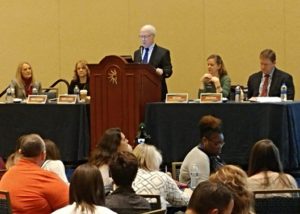
Dr. Botvin described the LST approach and the underlying theory of this positive youth development approach to substance abuse prevention. He also summarized the research evidence documenting the effectiveness of LST for preventing tobacco use, underage drinking, and illicit drug use. Among the most exciting research findings were those showing that LST can prevent prescription drug abuse and teen opioid misuse. Further strengthening the potential impact of LST to prevent opioid misuse is a new opioid and prescription drug abuse prevention module available either online as an e-learning program or as a classroom program in print form.
Dr. Botvin was joined at the morning Institute by community prevention leaders who described the success of LST implementation in their communities and included Ronna Yablonski, Executive Director of Cambria County (PA) Drug Coalition and Kat Allen, Coalition Coordinator of CTC Partnership for Youth, a Program of the Franklin Regional Council of Governments (MA). Rounding out the Institute was Craig Zettle, Vice President at NHPA, who addressed critical issues related to long-term sustainability of implementing prevention programs that have been tested and proven effective.
Those attending learned the theory underlying LST, as well as evidence of its effectiveness. Speakers also covered important dissemination issues regarding the adoption, implementation, and sustainability in schools, family, and community settings.
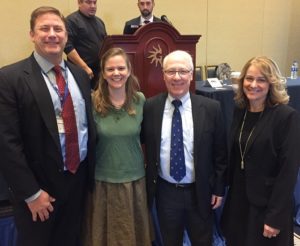
“We’ve come a long way in the field of prevention, and now it’s really about a risk-focused approach. In fact, the LST program has been tested through 35 years of rigorous scientific research that identified these approaches as effective, producing lasting results, and with the potential to save taxpayers a good deal of money,” said Dr. Botvin. “Let’s stop drug abuse before it begins. Now is truly the time to unleash the power of prevention.”
The LifeSkills Training program has been extensively tested and proven effective at reducing tobacco, alcohol, opioid, and illicit drug use by as much as 80%. Long-term follow-up studies also show that it produces prevention effects that are durable and long-lasting.
CADCA’s National Leadership Forum is the largest training event for the prevention field. Attendees learn strategies to address substance abuse and hear from prevention experts, federal administrators, and concerned policymakers. The Forum brings together attendees representing coalitions from all regions of the country and internationally, government leaders, youth, prevention specialists, addiction treatment professionals, addiction recovery advocates, researchers, educators, law enforcement professionals, and faith-based leaders.
Botvin LifeSkills Training Addresses Opioid Crisis with New Prescription Drug Module
WHITE PLAINS, N.Y. — Schools and communities are searching for new tools to combat the prescription drug and opioid crisis, now regarded as a national emergency. National Health Promotion Associates (NHPA), the researchers behind Botvin LifeSkills Training, have risen to the challenge of helping youth avoid the dangers of prescription drug or opioid misuse/abuse and are excited to announce the release of a Prescription Drug Abuse Prevention Module. 
The new LST Prescription Drug Abuse Prevention Module gives teens the skills and knowledge necessary to help them avoid the misuse/abuse of opioids and prescription drugs. It will be available in a variety of formats that will allow for both online and classroom delivery. The new module is ideal for school districts, community-based organizations, and agencies serving students ages 11 – 14. The module is flexible enough to enhance the award-winning Botvin LifeSkills Training program or to be integrated into existing prevention programming.
The new module is designed to further enhance the effectiveness of the LST Middle School program, which has been proven to reduce opioid and prescription drug misuse. A study funded by National Institute on Drug Abuse (NIDA) showed that the LST Middle School program delivered in 7th grade classrooms helped students avoid misusing/abusing prescriptions opioids and other drugs throughout their teen years. NHPA researchers say that the addition of this new module will reinforce the already effective LST program.
“NHPA is a leader in quality, effective evidence-based prevention education. While our core Middle School program already has evidence demonstrating its effectiveness in reducing opioid and prescription drug misuse and abuse, the addition of this new module will help to specifically address the epidemic facing our nation. The LST program has been tested through more than 30 years of rigorous scientific research and has identified prevention approaches that are effective, produce lasting results, and can save taxpayers a good deal of money,” said Dr. Gilbert J. Botvin, professor emeritus at Cornell University’s Weill Medical College and developer of the LST program. “Let’s stop prescription opioid abuse before it begins. Now is the time to unleash the power of prevention.”
More than 35 federally funded studies have demonstrated that LST protects teens against tobacco, alcohol, substance use, and other problem behaviors such as delinquency and violence. According to a 2013 report on the economic benefit of evidence-based prevention programs, LST produced a $38 benefit for every $1 invested in terms of reduced corrections costs, welfare and social services burden, drug and mental health treatment; and increased employment and tax revenue. LST had the highest return on investment of all substance abuse prevention curricula studied.
Kutztown Strong Reports Positive Outcomes for Substance Abuse Prevention Curriculum
Kutztown Strong, Kutztown Area School District and Kutztown University Institute of Addiction Studies report positive outcomes for students of substance abuse prevention curriculum.
Kutztown Strong finished out the last quarter of 2017 with presentations from research faculty from Kutztown University’s Institute of Addiction Studies.
In October, Professor William Bender, LSW, presented the outcomes of the LifeSkills evidence-based prevention curriculum delivered to 7th grade students by teachers in the Kutztown Area Middle School.
Having an extensive background in the administration of chemical dependency and mental health programs that spans more than 30 years, Prof. Bender discussed the history and development of the LifeSkills program, its purpose, and its learning objectives.
Data gathered by teachers then summarized collaboratively by Kutztown Strong staff and faculty of the Kutztown University, Department of Social Work, and Institute of Addiction Studies found 78 percent of the youth had a better understanding of the harmful effects of drug use after completing the course. Additionally, 62 percent of the students reported they were now less likely to approve of peer’s use of drugs, 43 percent increased skills in knowing alternate means of reducing anxiety, and 29 percent increased their knowledge of media’s potential negative influence on behavior.
Bender explained that the curriculum is designed to increase student knowledge of the harmful effects of substance use and refusal skills while decreasing motivations for use. These changes are expected to lead to long-term outcomes similar to those demonstrated in the programs randomized control trials which found tobacco use was cut by 75 percent, marijuana use decreased 66 percent and alcohol use declined 60 percent.
The Washington State Institute for Public Policy (http://www.wsipp.wa.gov/) estimates communities and society save up to $1256 in consequences from drug use for every youth that participates. The National Institute on Drug Abuse (2018) substantiates such savings noting that for every $1 spent on prevention, up to $12 is saved in reduced healthcare costs, overdoses, deaths, drug-related accidents, and increased productivity in life and work. (https://www.drugabuse.gov/).
The success of the program has led community leaders to pursue a grant to expand the program for 6th and 8th grade students in the district. Volunteers from Kutztown Strong, KASD, KU, and Berks County Council on Chemical Abuse (COCA) are collaborating on the grant writing project.
More Information: Read full article
Editorial: Don’t Forget these Proven Efforts to Prevent Drug Use
EDITORIAL:
There were many welcome recommendations in the report released in November by President Donald Trump’s commission on opioid addiction.
The President’s Commission on Combating Drug Addiction and the Opioid Crisis called for allowing inmates access to medication-assisted treatment in jail and continued treatment upon release. It recommended that people with substance use disorders who violate their probation terms by using substances be diverted into drug courts as opposed to prison. Among the 56 recommendations, it also called for more funding for addiction research.
But it could have gone further in its calls for enhancing prevention programming — especially at schools, which often find themselves dealing with the effects of the opioid epidemic whether they wish to or not.
In many cases, programs based in research are not just good for preventing or delaying drug use, but strengthening children’s social connections, ability to manage their emotions and decision-making skills.
To its credit, the report does mention specific interventions that have been shown to be effective, such as the Good Behavior Game for elementary schools, which rewards teams of students when they stick to classroom rules. Over time, students play the “game” for longer periods or at different times of the day, during various activities and in different locations. Teachers eventually hold off on giving rewards until the end of the day or week. The point is for children to learn that they are expected in all settings and at all times to show good manners.
One study found participating in the program was associated with reduced use of heroin and cocaine in early adolescence. Another study found it significantly reduced drug and alcohol use among males in particular.
The commission’s report also highlights LifeSkills Training, a school-based intervention for adolescents that teaches self-management and social skills, and how to deal with pressure to use drugs, alcohol and tobacco. Students examine how their self-image affects behavior and learn how to reduce stress and anxiety, overcome shyness and make good choices in tough situations.
The program has been evaluated in more than 30 scientific studies involving more than 330 schools or sites and 26,000 students in suburban, urban and rural settings, and has been shown to cut short- and long-term use of tobacco, marijuana and drugs, and reduce risky driving and fighting.
But while the commission’s report discusses these prevention programs, and others, it stops short of saying what the federal government’s obligation should be to make sure schools know about them and use them. While they are vastly less expensive than treatment or incarceration later in life, there is still a cost.
The Center for the Study and Prevention of Violence at the University of Colorado Boulder estimates the Good Behavior Game costs $81 per student in the first year, while LifeSkills Training costs $17 per student in the first year.
Instead of pushing for investing in these effective programs, the commission chose to advocate for two prevention measures: increased use of a screening tool to identify at-risk youth who may need treatment and a national public education campaign. The campaign would aim to raise awareness that addiction is not a moral failing but a chronic brain disease, and that treatment is available. While it’s a good message, mass advertising campaigns like this haven’t been particularly effective in the past.
They “can at most make a modest contribution to turning around the opioid epidemic, with some risk of making it worse if the lessons of past failed antidrug campaigns are not heeded,” wrote Austin Frakt, director of the Partnered Evidence-Based Policy Resource Center at the V.A. Boston Healthcare System, and Keith Humphreys, a professor at Stanford University School of Medicine, for The New York Times on Nov. 1.
“But the safest bet is that the results will be between those two end points: zero. To fight the opioid crisis, public money is probably best spent elsewhere.”
Instead of spending the money on a national campaign, it would be better to spend it on programs for youth that are already known to work.
More Information: Full article
National Institute of Justice Rates School Safety Programs
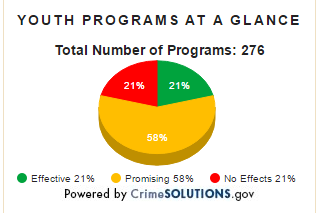
The National Institute of Justice (NIJ) has released “Find School Safety Programs on CrimeSolutions.gov.” This short video discusses how school, social services, and agencies can use the CrimeSolutions.gov clearinghouse to find evidence-based programs and practices that can improve school safety. The video also addresses the lack of strong evaluations of school safety programs that schools are implementing and investing in and how this presents an opportunity for research.
CrimeSolutions.gov includes almost 300 programs and practices on juvenile topics that are rated as Effective, Promising, or No Effects. The Botvin LifeSkills Training program is highlighted as Effective, with multiple studies showing it effects on violence and delinquency prevention.
CrimeSolutions.gov programs can also be found on the U.S. Department of Justice’s, Office of Juvenile Justice and Delinquency Prevention’s Model Programs Guide along with other evidence-based resources.


