
Category Archives: Prevention News
Substance abuse block grants will help educate Weiser students
FRUITLAND, ID- St. Luke’s has been awarded two Substance Abuse Block Grants from the Department of Justice through Idaho’s Office of Drug Policy, according to a news release from the medical facility.
These grants will support the continuation of St. Luke’s youth drug prevention programs in Weiser, in partnership with the St. Luke’s Coalition for Drug Free Youth, and will initiate the development of new drug prevention programs in Nampa.
The Coalition for Drug Free Youth has been in existence for almost three years and is tasked with addressing the issue of youth prescription drug and alcohol abuse in their area by providing information, enhancing skills, providing support, enhancing access/reducing barriers and changing policies related to drugs and alcohol.
The grant funds will enable St. Luke’s to provide the LifeSkills Training program, a comprehensive in-school drug prevention program, to seventh- and eighth-graders in Weiser and Nampa.
This program will help students develop lifelong refusal skills and valuable knowledge to make a drug-free lifestyle choice.
Botvin LifeSkills Training builds resilience in Dublin, Ireland, youth
Family Matters ABC and Barnardos Northern Ireland in partnership with local youth services, school completion projects and local schools launched the Botvin Lifeskills programme in Ballyfermot on Thursday 31st May 2018.
Botvin LifeSkills is a highly effective early intervention and prevention programme which prevents risk taking behaviours in children and young people. LifeSkills is a universal programme, designed for whole-class in school delivery. LifeSkills concentrates on a preventative approach which shares age appropriate information with children and young people providing them with the skills, knowledge and attitudes to make healthy choices. LifeSkills has three core parts:
- Self-management skills which help students with problem solving, decision making, critical thinking and how to regulate emotions
- Social competence which involves teaching students how to communicate clearly, make friends and develop healthy relationships.
- Resistance training to help young people develop strategies for resisting peer pressure.
As well as preventing risk taking behaviours, it also leads to important improvements in other skills which are key for healthy development amongst young people. These include self-esteem, emotional regulation, motivation, communication, social skills and ability to cope with stress.
Over the past two years the Lifeskills programme has been delivered in 4th and 5th classes in all primary schools in Ballyfermot and with 1st years students in St. Dominic’s Secondary school. The programme is facilitated by staff from the local youth services, Ballyfermot Youth Service, Cherry Orchard Integrated Youth Services and Familibase as well as the 4 clusters of the School Completion Programme and teachers in each of the Primary schools. A research report outlining the findings from the implementation of the programme was launched this afternoon also. This report highlights that 73% of children participating improved their knowledge of smoking and Lifeskills, 54% improved their attitudes to smoking and alcohol and 57% improved their overall Lifeskills.
Bernie Laverty, Coordinator with Family Matters said “We are all aware through experience and research that alcohol and drugs have impacted negatively on children, young people and families in Ballyfermot over many years. We are delighted to work with the LDATF, all our school communities and youth services in implementing the Lifeskills programme with a firm belief that this will support our young people to make healthier decisions as they transition into adulthood.”
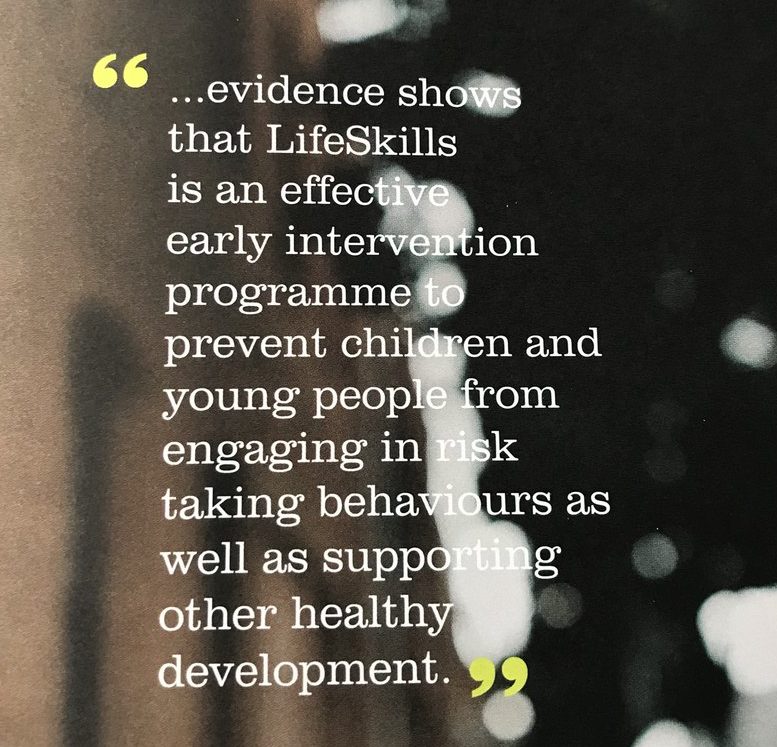
Julie Healy, Head of Programmes in Barnardo’s Northern Ireland said “This research clearly illustrates that LifeSkills has successfully been implemented in Ballyfermot by Family Matters ABC. This paper adds to the already well-evidenced outcomes that LifeSkills is an effective early intervention and prevention programme that prevents children and young people from engaging in risk taking behaviours as well as supporting other healthy development.”
Students Complete CADA LifeSkills Training Program in Bermuda
CADA, along with prevention partners, DNDC and PRIDE, handed out certificates to 81 OHS and Somersfield Academy, students for completing the Botvin LifeSkills Training Program.


CADA spokesperson, Mr. Anthony Santucci stated “LifeSkills Training [LST] is a research-validated substance abuse prevention program, proven to reduce the risks of alcohol, tobacco, drug abuse and violence by targeting the major social and psychological factors that promote the initiation of substance use and other risky behaviors. This comprehensive and exciting program provides adolescents and young teens with the confidence and skills necessary to successfully handle challenging situations.”
Local Schools Address E-cigarettes and Vaping with LifeSkills
Vaping, it seems, is everywhere, and school districts in Washington and Greene counties are educating teachers, parents and students about the dangers of using e-cigarettes and vape pens.
School districts also are updating drug and alcohol policies to keep the devices off school grounds.
In Greene County, Jefferson-Morgan School District Superintendent Joseph Orr said there have been a “handful” of incidents during the 2017-18 school year, and he anticipates incidents to rise as the popularity of the devices increases.
Federal regulations prohibit anyone under the age of 18 from purchasing the devices, but use of e-cigarettes and battery-powered vaporizers among teens – who inhale vapors from nicotine mixed with liquid in flavors including gummy bear, cotton candy and Mountain Dew – has exploded. E-cigarettes and vape pens have become popular with teens over the last few years, but they aren’t safe, according to Pennsylvania Deputy Secretary for Health Promotion and Disease Prevention Dr. Loren Robinson.
Smoking the devices “delivers cancer-causing chemicals to the body, and the flavoring used by many teens in these devices appears to be the most dangerous. Normalizing smoking for young adults through e-cigarettes introduces them to a lifetime of addiction,” said Robinson.
E-cigarettes and vape pens are part of a class of devices known as Electronic Nicotine Delivery Systems, which also include e-hookahs, e-cigars and e-pipes.
E-cigarettes now come in easily concealed, high-tech designs. One of the most popular e-cigarettes, Juul, resembles a USB storage device and can be charged by plugging it into a USB port. Each Juul cartridge contains as much nicotine as an entire pack of cigarettes.
“Juuls are the new thing. Kids are Juuling now, and you hear about kids Juuling during class,” said Martin. “They look just like a jump drive and a student could have one on the desk and you wouldn’t even know it.”
Pennsylvania high school students consume e-cigarettes at a rate higher than other students across the country. One in every four high school seniors in Pennsylvania reports having used an e-cigarette in a 30-day period, which is 10 percent higher than the national average. More teens used e-cigarettes in Pennsylvania in 2015, according to the 2015 Pennsylvania Youth Survey, than used cigarettes and smokeless tobacco.
Experts are concerned about the impact e-cigarettes have on teens. According to a recent study in the journal Pediatrics, teens who use e-cigarettes are up to three times more likely to have dangerous chemicals in their systems than teens who do not use, including chemicals known to cause cancer.
Teens who use e-cigarettes are also twice as likely to start smoking traditional cigarettes.
The report goes on to say that youth and young adults are also at risk for long-term, long-lasting effects of exposing their developing brains to nicotine, including nicotine addiction, mood disorders and permanent lowering of impulse control.
Spirit Lake Community Schools Launches New Partnership
An effort is underway in Spirit Lake to support sixth-grade students and their families with a lifetime of practical skills and in doing so, help prevent common problems.
The “PROSPER Partnerships for Student Success Project” is supported by Spirit Lake Middle School, Iowa State University Extension and Outreach Dickinson County and Iowa State University’s Partnerships in Prevention Science Institute. The project offers a multi-pronged approach to help preteens learn life skills while also offering new tools and resources for parents that can benefit the whole family.
“The project is designed to support students with a range of readily available prevention programs, while also providing resources for students who might benefit from additional support.” Dr. Richard Spoth, director for the Partnerships for Prevention Science Institute, said. “A range of tailored services are available for parents so they can decide what will be most helpful for their family.”
The project includes three key components:
• Empowering Families to Grow Together online series that provides opportunities for the entire family to learn to explore positive ways to relate to each other during the transition to the teen years.
• A web-based community resource directory that houses information about local and state organizations that can provide assistance.
“The preteen years are a time of tremendous physical and emotional change, as students develop unique identities and experience an increasing need for independence,” Spirit Lake Middle School Counselor Jill Dielschneider said. “We want to support parents in their effort to equip their preteens with skills that will enable them to develop their expanding world in healthy ways.”
Sue Boettcher is a community team facilitator representing ISU Extension and Outreach Dickinson County.
“In the end, we want to help each student be better prepared for their future in school, the workforce and as community members,” she said. “This is an investment in children and families that we hope will pay off with stronger communities in the future.”
High Schools Mobilize to Help Teens Combat Rise in Stress-Related Ills
Generation Z is the informal name given to those in their teen years now, who are ready to move into center stage after the Xers.
They were born tech-savvy with a smart phone in one hand and more electronic gadgets than any previous generation.
Yet, experts opine, it’s more challenging than ever to be a teenager.
Complaints of bullying through social media, combined with fears of school shootings, and even the unpredictable threat of terrorism, are all recent social and emotional issues that add to societal stress and impact teens.
Closer to home, TUHSD is working diligently to offer support services and classes to better prepare these worldly-wise youth for the demands of living in a complex world.
Dr. Lisa Merrin, lead psychologist for the district, says that counseling services are available to TUHSD students who ask for them.
“We are invested in creating an atmosphere where students learn to advocate for their own needs, and where seeking support is seen as strength, rather than a weakness,” said Dr. Merrin.
“We also have been working toward more staff training, so that more staff—beyond those who counsel formally—knows how to respond to a student who reaches out for help or guidance. We know that not all students are comfortable seeing a counselor or other mental-health support person as a first step.”
For students reluctant to ask for support, Merrin says staff is also trained in a threat assessment process to identify those students who may pose a problem.
“If there is a concern that a student may pose a threat, there is a team process that is triggered where data is gathered and analyzed, and a plan of support is generated based on the information identified in this assessment,” said Merrin.
During these difficult times, Merrin and other mental health staff can respond; although, having services that are offered on an as-needed basis is critical to avoid problems escalating.
“We have a number of supports for student counseling on our campuses. We have guidance counselors, school psychologists, school social workers, and behavioral interventionists,” said Dr. Merrin, “all of whom may see students in crisis; but, also for planned, proactive counseling to help them problem solve, to learn coping skills, and to be able to re-enter the classroom focused on learning. “
The district also partners with the city of Tempe to have their prevention counselors on high-school campuses.
In addition to mental-health services for students, TUHSD adopted the Botvin LifeSkills Traning program for all youth who are freshman or sophomores.
Jennifer Liewer, executive director of Community Relations for the district, says that the program,” is a highly interactive, skills-based program designed to promote positive health and personal development for youth in grades 9 or 10. Currently, the program is funded for a total of three years and this is the first year.
“The program is an integrated approach that helps develop personal, interpersonal, and drug resistance skills. It is taught over the course of ten-class periods and every student enrolled in a TUHSD PE class is learning the curriculum.”
The curriculum is designed to strengthen student abilities in the following areas:
- Personal Self-Management Skills: Students develop strategies for making healthy decisions, reducing stress, and managing anger.
- General Social Skills: Students strengthen their communication skills and learn how to build healthy relationships.
- Drug Resistance Skills: Students understand the consequences of substance use, risk-taking, and the influences of the media.
The district’s website lists extensive information on additional community resources and mental health services as well at www.tempeunion.org
LifeSkills in the Classroom: CFR Teaches Drug Abuse Prevention
As children make their way through school, there’s a strong chance that a local treatment center has educated them about the dangers of drug abuse, including opioid abuse.
Community and Family Resources, with the help of a grant, visits area schools and offers a variety of programs for the students to educate them about drug abuse.
Corey Keller, a prevention specialist with CFR, is one of the people who visits the classrooms.
The Comprehensive Substance Abuse Prevention Grant, which is provided through the Iowa Department of Public Health, allows for the programs to happen.
“One of the big things we do is we implement evidence-based curriculum in schools,” she said. “And we can do a couple different curriculums.”

-Messenger photo by Peter Kaspari
Radney Roosa, who teaches LifeSkills programming at Fort Dodge Middle School, asks his class to fill out a list of positive behaviors during a recent class session.
LifeSkills Training is a program that is presented to seventh-graders at Fort Dodge Middle School, and is held in conjunction with the students’ health classes.
“It’s a 15-session curriculum that is not only drug prevention, but also violence prevention, goal-setting, decision-making, assertiveness,” she said. “It’s kind of those behavior strategies, too.”
Keller said students seem to enjoy participating in both programs.
And she said evidence shows that the programs are working.
For LifeSkills Training, Keller said last year, the class had a section dedicated to opioid abuse and prescription drug abuse.
She added that the class will also use real-life news stories in the class, which she said helps drive the point home about what’s going on with drug abuse.
“The kids have responded really well to that,” she said.
Fort Dodge Middle School Principal Ryan Flaherty said Life Skills is also a very important program for middle-schoolers in particular.
“We know that the middle school years are super important for the development of kids in which they’ll be making lots of decisions, facing lots of pressures to do certain things,” Flaherty said. “And we believe our greatest tool to help students make the right decision is education. Instead of reacting when things go wrong, we want to promote healthy lifestyles, educate students and give them the skills to make healthy decisions when they’re faced with those as they grow up.”
He added that the students have benefited from the program.
“I think our students want the information and I think they want the ability to do the right thing,” he said. “Proper education gives them the ability to do that.”
CFR provides all the materials itself, according to Keller. The school district doesn’t have to pay anything.
“We’re not training the teachers to do it,” she said. “We’re actually doing it and teaching the curriculum.”
All the teachers do is schedule the time for CFR to come in and decide which grades they want to be educated about drug and substance abuse.
“A lot of times it’s fourth and sixth grade,” Keller said. “In Webster (County), that’s where we’re currently implementing it.”
She added that CFR is always interested in coming to speak at schools if teachers are interested.
“If there is a specific topic that any teacher, administrator wants to hear more about, whether it’s e-cigarettes or marijuana concentrates or mixing alcohol and energy drinks,” she said, “we’re willing to come in and present.”
Somerset County Unleashes Power of Collaboration
LETTERS TO THE EDITOR
By BILL McKINNEY, President, United Way of the Laurel Highlands bill@uwlaurel.org
One of the benefits of working in several counties is the ability to witness and experience how individuals and organizations work together for the betterment of their residents and communities.
At the United Way of the Laurel Highlands, we get to experience this first hand due to our work and responsibilities in both Cambria and Somerset Counties.
One glaring spotlight is on how Somerset County uses the power of collaboration, especially in the critical area of drug and alcohol prevention programming, to improve the lives of their youth and future of the region.
The results being achieved in Somerset are impressive, and are a blueprint for others to follow. All 18 risk factors measured show a significant reduction, 48 percent on average, in risky behaviors including, binge drinking, marijuana usage, prescriptions abuse, and many others. They are moving quickly in the right direction!
This does not happen by chance, or by adopting short-term feel good approaches; but with a vision that includes open collaboration with all stakeholders welcomed, implementing evidence based programming proven to deliver measurable results, and a long-term focus of funding to scale and sustainability.
Somerset County has all the ingredients for success. An inclusive and transparent County Drug & Alcohol Unit (referred to as the Single County Authority – SCA), a respected and effective program provider in Twin Lakes Center, engaged and receptive school districts, unwavering support by Somerset Hospital and the Somerset County commissioners, with strong leadership throughout those listed.
Molding all of these ingredients is Drug Free Communities; a large and diverse coalition of Somerset County non-profit, government, hospital, school, law enforcement, state legislative, district attorney, faith based, and business representatives; all working together for a drug-free Somerset County.
The United Way of the Laurel Highlands is proud to be a partner with all of these collaborative organizations and individuals.
Somerset County’s inclusive and collaborative approach is paying off in many ways. To learn more about their results visit our website at www.uwlaurel.org/youthdrugandalcoholprevention
New Phila fourth-graders complete drug-abuse prevention classes
Botvin LifeSkills Training is backed by over 30 scientific studies and is recognized as a model or exemplary program by an array of government agencies including the U.S. Department of Education and the Center for Substance Abuse Prevention.
NEW PHILADELPHIA, OH – Fourth-graders at South Elementary School had a graduation party Friday, but not because they have finished their education. Their observance capped an eight-week program designed to teach them how to avoid using drugs, alcohol and cigarettes.
Children and parents reacted favorably to the lessons, called Takin’ It to the Schools, which made their debut in New Philadelphia City Schools fourth-grade classes this school year.
“I think it’s good that they’re teaching the kids at an early age,” said Michael LaBiche, who attended the pizza party that capped the sessions at South Elementary School on Friday. Waiting until high school, when students may have already been exposed to harmful options, might be too late.
Principal Jackie Triplett said the program went well, with students taking the class during lunch and recess.
“I think fourth grade is the a perfect grade level to start with, and they certainly are maturing,” she said.
Fourth-grader Landon LaBiche said he learned that cocaine, marijuana and beer are not good for you.
Fellow student Asher Zimmerman said he learned about “not smoking and doing bad stuff like that. It hurts your teeth and your lungs and it’s really bad for you.”
Offering students the medical reasons for avoiding harmful substances was a valuable part of the curriculum, Michael LaBiche said.
Parents John Crites and Laura Warner said they would “absolutely” recommend that other parents allow their children to go through the Takin’ It to the Schools lessons.
Participants’ self-esteem building activities included writing positive traits about their classmates on paper drawings of diamonds. Several students said they were unaware of the attributes mentioned by others.
“So there’s things that our friends see in us that we don’t see in ourselves,” said Samantha Wottle,
Takin’ It to the Schools facilitator.
“Self-esteem is one of our most important lessons,” said Tammy Thacker, Takin’ It to the Schools facilitator. “It plays in everything.”
“I think I learned to be more open to things, just to be more stress-relieved,” said student Abbie Warner. ”
Students talked about things they could do, such as taking a nap or playing a game, when they become overly stressed.
Student Makenna Smith talked about the decision-making skills she learned.
“It taught me to be careful about what I do, especially if somebody is asking me to do something that is not good for me,” said Makenna Crites.
“It taught me how to say ‘no’ to something,” said Mya McGhee. “I would walk away and just say, ‘No, not right now.’ Overall, I loved this program.”
Personal & Family Counseling Services has been offered Takin’ It to the Schools in Tuscarawas and Carroll counties since 2002. It has been in Dover, Tuscarawas Valley, Indian Valley, Newcomerstown, Garaway, Claymont, Carrollton, and this year added Connotton Valley, Brown Local and New Philadelphia City Schools. It served 2,282 students in 2017-2018 school year.
The program uses the Botvin LifeSkills Training program. It is administered primarily to students in grades four and five in the county, with a few schools continuing with it in the middle school. It is designed to help students build self-confidence and develop coping skills to combat the risk factors known to promote unsafe behaviors.
The Personal & Family Counseling staff meet with students once a week for eight weeks, with a different topic each session. Topics include self-esteem, decision making, tobacco, advertising, anger and stress management, communication skills, social skills and assertiveness. Facilitators look at eight target areas and work to develop students’ strength in these areas, according to Jodi Salvo, Takin’ It to the Schools coordinator. Each session includes both an educational component and a hands-on learning activity that demonstrates how each lesson can be applied.
Rather than merely teaching information about drugs, Salvo said, Botvin LifeSkills Training consists of three major components that cover the critical domains found to promote drug use. Research has shown that students who develop skills in these three domains are far less likely to engage in a wide range of high-risk behaviors.
- Drug resistance skills, which enables young people to recognize and challenge common misconceptions about tobacco, alcohol and other drug use. Through coaching and practice, they learn information and practical skills for dealing with peers and media pressure to become users.
- Personal self-management skills, in which students learn how to examine their self-image and its effects on behavior; set goals and keep track of personal progress; identify everyday decisions and how they may be influenced by others; analyze problem situations, and consider the consequences of each alternative solution before making decisions; reduce stress and anxiety, and look at personal challenges in a positive light.
- General social skills, in which students develop the necessary skills to overcome shyness, communicate effectively and avoid misunderstandings, initiate and carry out conversations, handle social requests, utilize both verbal and nonverbal assertiveness skills to make or refuse requests, and recognize that they have choices other than aggression or passivity when faced with tough situations.
Botvin LifeSkills Training is designed to use developmentally appropriate and collaborative learning strategies taught through lecture, discussion, coaching, and practice to enhance students’ self-esteem, self-confidence, ability to make decisions, and ability to resist peer and media pressure.
The program was developed by Dr. Gilbert J. Botvin, a leading prevention expert. It is backed by over 30 scientific studies, Salvo said, and is recognized as a model or exemplary program by an array of government agencies including the U.S. Department of Education and the Center for Substance Abuse Prevention.
Johnstown Middle School Students Learn about Drug Abuse
Johnstown, Cambria County, Pa. – Education is a buzzword when it comes to preventing drug abuse, but what does that look like?
Thursday morning, 6th graders at Johnstown Middle School learned how to make good decisions.
As part of the Botvin Lifeskills Training, students learn about drugs and substance abuse: like where marijuana comes from, what are its side effects and how can drug use hurt a developing brain?
Botvin Lifeskills Training is an evidence-based substance abuse prevention program.
“Not only does it prevent drug use, but it prevents violence, which is a great thing here for our community,” said Kate Porter, the education prevention specialist for the Cambria County Drug Coalition.
In Cambria and Somerset County, Botvin is funded by nonprofits and substance abuse prevention agencies, including United Way of the Laurel Highlands, Twin Lakes Center, County SCA’s, Cambria County Drug Coalition, Somerset Drug Free Communities, Pennsylvania Commission on Crime and Delinquency, and the University of Colorado.
It first launched in area schools in 2011. Now, it’s reached more than 7,000 students in all 24 school districts in the two counties.
In the first four years, statistics show decreases in alcohol, tobacco and marijuana use for 6th – 12th graders.
The program teaches students about the dangers of substance abuse, along with coping and social skills and how to resist peer pressure.
“It focuses on self-image, how to cope with anger, how to cope with anxiety. It does have lessons on tobacco, marijuana and alcohol. However, the point of the program is to build resilient youth,” Porter said. “So, I believe that if we start young, we will give the youth the skills that they need by the time they are faced with these tough decisions.”
Next year, the Greater Johnstown School District will add the training for 5th graders. The Cambria County Drug Coalition is also working to bring the curriculum to 3rd graders across the county.


