

Category Archives: Prevention News

Shelbyville Central Schools, partners with Girls, Inc. for substance abuse program

Shelbyville Central Schools recently partnered with Girls, Inc. after receiving the “Cures Substance Abuse” grant  from the Indiana Department of Education.

Shelbyville teachers now have the option to teach the the Botvin Lifeskills Training Program or another prevention curriculum on their own, or they can co-teach with the Girls, Inc. teacher, who has not been hired.

The Botvin LifeSkills Training middle school program has 15 lessons and 10 for the high school which focuses on personal self-management skills, general social skills, and drug resistance skills.

Read full article: SCS partners with Girls, Inc. for substance abuse program


Groups offering free prevention trainings

In Ohio, the Tuscarawas County Anti-Drug Coalition is partnering with Personal & Family Counseling Services to offer a series of free prevention education trainings to schools in order to strengthen the community by equipping people with proven prevention tools.

Free trainings include the Botvin LifeSkills Training program where participants will receive a comprehensive, dynamic and developmentally appropriate substance abuse and violence prevention program designed for upper elementary school students. This highly effective curriculum has been proven to help increase self-esteem, develop healthy attitudes, and improve students’ knowledge of essential life skills – all of which promote healthy and positive personal development.

Read full article: Groups offering free prevention trainings

Learning LifeSkills in Iowa

The Audubon and Exira-Elk Horn-Kimballtion schools in Iowa, in collaboration with the Healthy Teen Coalition, and New Opportunities through the Iowa Partnership for Success (IPFS) Grant, are providing the LifeSkills Training (LST) program, an evidence-based substance abuse prevention curriculum that teaches skills such as personal self- management, general social skills, and drug and alcohol resistance.

This school year is Audubon’s and Exira-EHK’s second year in teaching LST curriculum to their health class students. Recent student survey results show the curriculum is making a positive impact on the students’ view of risk and possible consequences of underage drinking and youth binge drinking.

Read full article: Learning LifeSkills


To Tackle Drug Epidemic, LaPorte County to Focus on Prevention

In the wake of an opioid epidemic in LaPorte County, IN schools there are designing programs to prevent youth substance abuse with the help of $2 million in grants over the next four years from the Healthcare Foundation of LaPorte.

The LaPorte County plan, Partners in Prevention, is modeled after one in Marion County called Prevention Matters, funded by the Indianapolis-based Richard M. Fairbanks Foundation.

The 12 LaPorte County schools are choosing their programs now with the intention of implementing them in the fall. One of the most popular ones in Marion County has been LifeSkills Training, which teaches 8- to 14-year-olds social, self-management and drug-resistance skills.

The Healthcare Foundation of LaPorte will fund one year of planning and three years of implementation. After that it’s up to the schools to keep the programs going on their own.

Read full article: LaPorte County to focus on prevention

Preventing Rx Drug and Opioid Abuse with LifeSkills Training; Webinar 2/12 at 1pm ET

Prescription drug abuse is an epidemic that demands immediate attention. A growing number of children and adolescents in the United States are dying from opioid poisonings, a new study shows.

lifeskills-training-prescription-rx-module

Recently, many schools and communities have contacted us in search for new tools to combat the current opioid crisis. Our research team has developed a Prescription Drug Abuse Prevention Module which gives teens the skills and knowledge necessary to help them avoid the misuse/abuse of opioids and prescription drugs. The module can be used as an additional lesson in the LifeSkills Training (LST) Middle School program (ideally implemented after the Assertiveness chapter), or as a stand-alone module.

The new module is designed to further enhance the effectiveness of the LST Middle School program, which has already been proven to reduce opioid and prescription drug misuse. The addition of this new module reinforces the already effective LST program.

Join us for this informative webinar where we will present the most recent state of the opioid epidemic, and explore ways for you to implement this module in coordination with existing LST implementations or as a standalone module.

Date: Tuesday, February 12, 2019

Time: 1:00pm ET

Duration:  45 minutes

Cost: Free

Presenter: Craig Zettle has presented at national and international conferences over the last 20 years.  He has been active in prevention education with the Botvin LifeSkills Training program for the last 15 years and regularly consults with schools, districts, federal and state agencies, as well as community-based organizations on the implementation and support of the LifeSkills Training program.

Register to reserve your spot

Rogers County Youth Services receives seal of transparency

Rogers County Youth Services, the Claremore, Oklahoma-based non-profit, was recently recognized with the GuideStar Platinum Seal of Transparency, to honor to organization’s commitment to transparency in the use and results of donations.

RCYS Executive Director Herb McSpadden said transparency is important to RCYS because, “We want to make sure that when people donate to us, they are aware of what they are giving to and that the money they give is going to services, not being wasted.”

GuideStar is a free, online, searchable database of over two million national nonprofits, which gives users access to all of the publicly available information about any given nonprofit. The platinum designation is the highest level of recognition offered by GuideStar, an opt-in service where nonprofits can give the website more information about themselves than that found in IRS records.

The organizations annual budget of just over $560,000 is allocated toward counseling services, the Love and Logic Parenting Program, the Parenting Through Divorce Program, the family academy program, Botvin LifeSkills Training, the iCrimes program and the U-Turn Academy Program.

LifeSkills Training is done by request, with $40,000 budgeted each year. Certified instructors of the evidence-based Botvin LifeSkills Training curriculum give free presentations to area 4th, 5th and 6th grade students, with proven success reducing drug use, alcohol use, violence, and tobacco use.

The Botvin curriculum is taught in the classroom for a semester, where the student’s regular teacher and the life skills instructor co-teach. Students have work books for the skills and take pre- and post- training tests to assess how much students learned from the lessons.

“It teaches the kids how to say no to peer pressure, how to have better self-esteem, how to watch out for and take care of each other and it builds empathy,” McSpadden said.

There has been a steady rise in the number of K-12 students taught the life skills material since 2014, from 220 to 320 in 2018, and an expected 600 in 2019.

“With the expansion of counseling and prevention services as well as the development of new programs, RCYS will provide counseling services to approximately 500 individuals and families this year, and approximately 850 individuals and families in FY21,” GuideStar indicates, “Through our education and prevention groups/classes, RCYS will provide services to an estimated 1,200 students this year, growing to 2,500 students during FY21.”

Read full article: Rogers County Youth Services receives seal

Nanticoke Health Services donate to schools for Sussex Goes Purple

Representatives from Nanticoke Health Services recently visited several elementary schools to distribute purple bracelets to third- through fifth-grade students.

The bracelets, which have “Choosing Me. Drug Free” printed on them, were given to students at Phillis Wheatley Elementary School in Bridgeville, Central Elementary School and Fred Douglas Elementary School in Seaford.

The idea to donate the bracelets was inspired by Gracy Hudson, a third-grader at Phillis Wheatley Elementary. Gracy learned about the Go Purple initiative at her church and wanted to spread the message to her friends and classmates.

Nanticoke’s donation is a part of Sussex Goes Purple, a community effort to end substance abuse through awareness and prevention. Sussex Goes Purple launched in September as a part of national substance abuse awareness month.

Sussex Goes Purple is organized through the Sussex County Health Coalition, which is also spearheading the peer to per Botvin LifeSkills Training program in Seaford High and Middle schools. Botvin is a nationally known program that mentors youth, empowering them to make healthy life decisions. Sussex Goes Purple is supported by the Delaware Division of Substance Abuse and Mental Health, Highmark and all three hospitals in the community.

Read full article: Nanticoke Health Services donate to schools for Sussex Goes Purple

Can you hear me now? Students taught importance of effective communication, listening in a text-first world

CAMBRIA, PA – Northern Cambria history teacher Dan Pajak stood in front of a classroom full of seventh-graders and rattled off a brief list of instructions.

Draw a circle.

Add a triangle inside it.

Then add a square in the corner.

The 22 students listening to his assignment sketched out his commands 27 different ways on the small sheets of paper in front of them.

“To get my message across as a teacher, I need to communicate effectively. I have to be direct,” he said, noting that without vital details about where he wanted each shape placed, it was almost impossible to carry out the task.

Pajak was delivering a lesson on effective communication Tuesday as part of a character education class at the school.
Botvin Skills

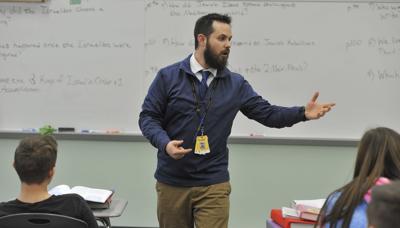
Northern Cambria middle school teacher Dan Pajak uses verbal and non-verbal skills to demonstration to his students the importance of effective communication during a Botvin LifeSkills class on Tuesday, Dec. 11, 2018.

In today’s text-first world – with kids increasingly relying on cellphone messaging and other technology to communicate – the crucial, timeless elements to both verbal and nonverbal expression are often lost in translation, the teacher said.

And that could lead to a lifetime of problems, he said.

Pajak was working to change that course, delivering a lesson through Botvin LifeSkills Training, an evidence-based program aimed at guiding youth toward healthy habits that can prevent them from falling into violent or addictive patterns.

United Way of the Laurel Highlands, The Learning Lamp and Alternative Community Resource Program adopted the nationally recognized Botvin program in 2011. Over the years since, Botvin programs have been implemented in classrooms in grades 3 through 8 across the region.

With support from the Cambria and Somerset’s single-county authorities, the Cambria County Drug Coalition and the Twin Lakes Center, the interactive, hands-on training program has since been expanded into every school district in the two-county area, according to United Way Community Relationship Manager Matt Spangler.

Spangler oversees youth prevention programs for the local United Way.

Botvin is taught to students over eight to 10 sessions that delve into a variety of life skills, such as anger management.

The side effects of drugs and alcohol are also discussed.

But other topics, including communication skills, are just as important for guiding young adults down productive paths, Spangler and Pajak said.

“If you have the skills and abilities to manage situations in your life that come into play, it’s going to reduce the chances you’ll fall into destructive patterns,” Spangler said.

Pajak noted that today’s elementary-age learners were born into a world of text messaging and an array of communication technology.

He talked with students about the importance of communicating effectively – sending the same, direct message using words, eye contact and body language, as well as recognizing when to stop and listen to someone else.

‘You’re going to have to listen to directions later in life, too,” Pajak told the class.

And the stakes will rise, he added.

Whether someone finds work as a welder, police officer or power-line worker, “if you don’t listen to people when they are trying to tell you something, bad things will happen,” he said. “If you are outside your home and you don’t pay attention to the guy who shows you how to cut down a tree properly … you could be in real trouble.”

An important conversation with a relative, a boss or a spouse could lead to breakthroughs or breakdowns, depending on how those encounters are handled, Pajak said.

Seventh-grade student Jackson Sheredy said this is his second year taking Botvin “character-building” classes, and it’s a lot different than the rest of his course load, he added.

“We’re talking about a lot of things – anger management or body language – that you don’t even really think about every day,” he said.

Even a task as simple as relaying a message can be handled differently – by senders and receivers – particularly by generations that grew up communicating differently, he added.

“When (Pajak) mentioned how our grandparents communicate with home phones, it reminds you how everything changes over time,” Sheredy said.

Such generational gaps can create barriers, especially during the teen years, Pajak said, but the solution to overcoming the hurdles hasn’t changed.

“There are a lot of kids out there who aren’t making the wisest decisions in the world, and a lot of times, it’s because they weren’t paying attention to something someone was trying to tell them,” Pajak said.

“It’s amazing how much you can learn if you listen and pay attention.”

Whether it’s a problem in school, with a friend or with drugs in the neighborhood, the best response is to communicate, he said.

“Don’t let it go and have it turn into something bigger than it already is,” Pajak said.

“Speak up.”

Read full article: Can you hear me now?

Eastbrook Junior High Incorporates New Life Skills Program

MARION, IN – Eastbrook Junior High School is introducing the Botvin LifeSkills Training program into their curriculum.

Jordan Steiner, a school counselor at Eastbrook Junior High said that Botvin is also a substance abuse prevention program.

“It is prevention-based,” he said. “It’s not intervention, but it is prevention.”

According to www.lifeskillstraining.com, Botvin is proven to reduce drug use by up to 75 percent, alcohol use by up to 60 percent, and tobacco use by up to 87 percent.

Steiner said the program can be taught seamlessly from elementary to high school and is said to have four to six years of effect with the students.

“I do look forward to it having a good impact with our students who are middle schoolers,” he said. “Based on the program, (the students) should have success of being out of the drug scene, being opioids and alcohol, in high school.”

Sue Jackson is the Health and P.E. Teacher at Eastbrook Junior High. She said her hope for this new program is that students will learn about decision making.

“When I taught health before … we did a whole unit on decision making,” Jackson said. “So it’s similar to (Botvin), just teaching them how to make wise decisions, And hopefully that will carry over into all other aspects.”

Steiner said his hope is that students will find a resistance to even want to try drugs and an acceptance of wanting to resist it.

“Research shows that you don’t just jump in and are addicted,” he said. “It’s a progression of being around it, being okay with it, being around seeing others do it … and then you try and then something happens in your life, and then you try more and you become addicted.”

Steiner said that drug use hasn’t been prominent at the student level. He said he’s seen drug use affecting student life more from outside the school.

It’s more of the outside the high school and parent level,” he said. “(Their) parents are incarcerated, parents are currently users or parents lost custody of their children … that’s the effect that I’ve seen with drugs and the county.”

Elizabeth Duckwall is the Eastbrook Junior High Principal.

“We certainly see those effects from other users and it definitely has an impact on the students when they’re being removed from their parents in the home and then placed with, sometimes, people they don’t know at all,” she said. “We’ve had cases where the student may have to move to a completely different area of the country because of drug use.”

Throughout the various forms of drug prevention in Eastbrook Junior High, Duckwall said she hopes this will spread to the communities around their students.

“I would hope that even beyond (students) not being users, if they could spread that message to those around them, whether it be younger siblings, friends, some cases even adults around them … sometimes having those conversations can be positive.

Read full article: Eastbrook Junior High Incorporates New Life Skills

Washington Middle School Program Encourages Students to Make Healthy Choices, Helps Parents Communicate

Washington, IA – Helping students make healthy choices is the goal of the Partnership for Student Success Program at Washington Middle School. Principal Curt Mayer explains the pilot program started with Iowa State University. In phase one, sixth-grade students took an at-risk survey to see what concerns and behaviors students were exhibiting. In phase two, research-based LifeSkills curriculum was added to the school’s health program. Mayer says they’re now in year three of implementing those lessons of social, behavioral, and emotional skills, “It deals with lessons related to drugs, alcohol, at-risk behaviors, social issues and concerns, those types of things. And then we also partnered with Iowa State Extension Office, and Amy Green comes in and does our fidelity checks to make sure that we’re teaching those with fidelity and if there’s any questions or concerns that we might have, and then how Iowa State Extension Office and then support us and our community.”

Read full article: Washington Middle School Program Encourages Students to Make Healthy Choices