





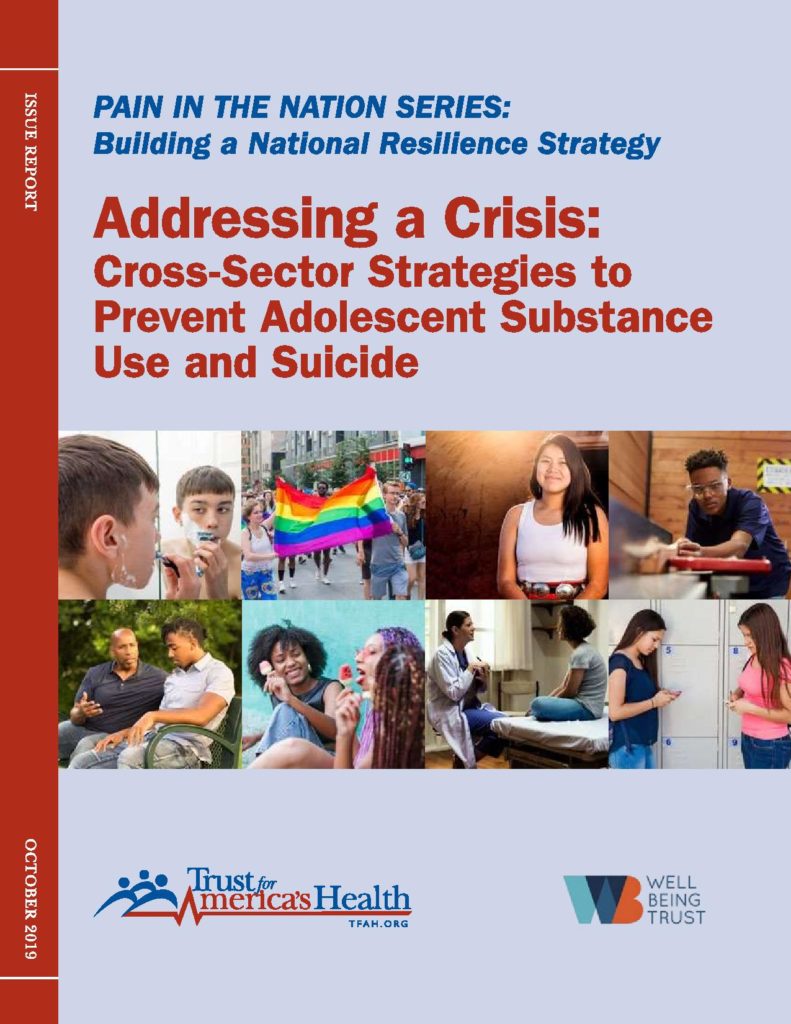
Trust for America’s Health Releases Report: Addressing a Crisis: Cross-Sector Strategies to Prevent Adolescent Substance Use and Suicide
Trust for America’s Health released a report on the health and well-being of adolescents as an effort to advance a National Resilience Strategy. The report highlights several Blueprints-certified programs including the Botvin LifeSkills Training program.
The report highlights what works to decrease risks and build protective factors noting that strategies reducing adolescent substance misuse, suicide, and other negative outcomes will require an integrated, multi-sector approach grounded in prevention.
One of these prevention strategies is to build social and emotional skills during adolescence. Examples of social and emotional skills include emotional regulation, impulse control, stress management, and positive relationship skills.
“Social and emotional skills are key risk or protective factors for substance misuse and mental health disorders. Adolescents with poor social, communication, and problem-solving skills are at increased risk for depression; and those with poor coping skills are at increased risk for substance misuse. In contrast, studies closely link high levels of social and emotional skills to resiliency—or the ability to achieve or maintain positive outcomes in the face of adversity, such as poverty, discrimination, or trauma. Resilient adolescents are less likely to engage in risky behaviors— like substance misuse—and are better able to positively cope with stress.“
The report states that SEL programs implemented in early and middle childhood positively affects all measures of adolescent well-being.
“LifeSkills Training program, a three-year prevention curriculum for middle school students, promotes healthy alternatives to risky behaviors through activities that teach students the skills to resist peer pressure to smoke, drink, or use drugs; help students develop greater self-esteem and self-confidence; help students cope with anxiety; increase student knowledge of the consequences of substance misuse; and enhance decision-making and problem-solving skills. Evaluations over the past 20 years have found the program reduces the prevalence of tobacco, alcohol, and illicit drug use by 50 to 87 percent, and when combined with booster sessions, reduces long-term substance misuse by as much as 66 percent, with effects lasting beyond the high school years.”
You can read the report here: https://www.tfah.org/wp-content/uploads/2019/11/TFAH2019TeensPainRptFINAL10_24.pdf